If you've ever gotten two quotes for the same display stand — one using UV printing and one using regular printing — you've probably noticed a big gap in price. Sometimes UV printing can cost two or three times more for what looks, at first glance, like the same job. So what exactly is UV printing, why does it show up so often in the display and signage industry, and why does it come with such a premium over regular printing? Let's break it all down.
UV printing is a digital method that uses ultraviolet light to cure ink, adhesives, or coatings instantly.
This means your print dries as soon as it hits the surface. No waiting around.
You can print on a wide range of materials—paper, metal, acrylic, glass, wood, ceramics, and more.
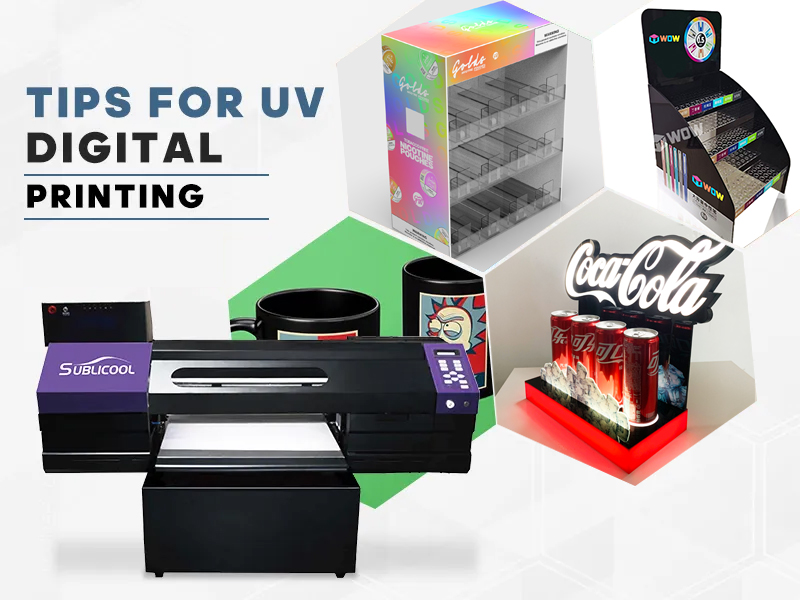
What really determines whether a display rack needs UV printing isn't the shape or purpose of the rack, but the material it's built from. Any display rack made of a smooth, rigid, non-absorbent surface will struggle with regular ink, which beads up, smears, or peels off because it has nothing to soak into.
UV ink solves this problem because it doesn't rely on absorption at all; it simply cures and bonds to the surface on contact. That's why the following types of display racks typically require UV printing:
- 아크릴 진열대 – smooth, glossy, and transparent, acrylic makes ordinary ink slide right off; UV printing lets graphics bond directly to the surface while keeping the material's glassy, light-catching look, which is exactly the premium finish retail brands want for point-of-purchase displays.
- PVC and foam board display racks (Sintra/Forex board) – common in lightweight, portable retail signage and countertop displays, these boards are non-porous and print poorly with regular ink.
- Wood and MDF display racks – used in mid-to-high-end display props and furniture-style fixtures, where a sealed or coated wood surface won't absorb standard ink evenly.
- 금속 디스플레이 랙 (aluminum composite panels, stainless steel) – common for durable outdoor stands and premium nameplate-style displays, where regular ink would flake off metal almost immediately.
- Glass display racks and shelving – used for upscale storefront branding and shelf dividers, where a fully non-absorbent surface makes UV curing the only reliable option.
- Ceramic tile and rigid plastic display fixtures
- Curved or irregularly shaped display racks, which can be handled by hybrid UV printers with flexible print beds, something regular printing equipment generally can't do.
So the accurate way to describe it is this: UV printing is suited to any hard, smooth, or non-absorbent material that ordinary ink can't properly bond with.
"Regular printing" is a broad term covering conventional printing methods that rely on absorbent materials and ink that dries either by air, heat, or absorption into the surface. The most common types include:
- Offset printing – ink is transferred from a printing plate to a rubber blanket and then onto paper or cardboard. This method is extremely efficient for high-volume runs and is the industry standard for magazines, books, and packaging.
- Digital printing (inkjet/laser) – ink or toner is applied directly to paper and dries through absorption or heat. This is common for shorter runs, proofs, and on-demand printing.
- Screen printing – ink is pushed through a fine mesh stencil onto fabric, paper, or certain plastics, then air-dried or heat-cured. It's popular for t-shirts, banners, and some rigid signage with simple, bold designs.
These methods are dependable, fast, and cost-effective, especially at scale. Their limitation is that they generally need a porous or slightly absorbent surface to work properly. That's why regular printing is excellent for posters, packaging, brochures, and paper-based signage, but tends to underperform on rigid, glossy, or three-dimensional display materials — the ink either won't stick, dries unevenly, or scratches off easily.
1. 방법
Regular printing follows a relatively simple, single-step logic: ink is applied, then it dries or is absorbed into the paper, and the job is finished. UV printing adds an extra, more technical step — every single pass of ink must be instantly cured with UV light before the next layer or color can be applied. On top of that, UV printers are often used to build raised textures, spot varnishes, embossed effects, and multiple layered passes to create a more tactile, dimensional print. This layering and instant-curing workflow is inherently more complex and time-consuming than a standard flat print run, and that complexity is reflected directly in the price.
2. 기계
UV printers are specialized flatbed or hybrid printing machines fitted with UV-LED or mercury-vapor curing lamps, high-precision print heads, and often a vacuum bed system to hold rigid boards perfectly flat during printing. These machines are considerably more expensive to purchase, calibrate, and maintain compared to standard offset presses or digital printers. The UV lamps themselves are a consumable cost, the print heads require careful upkeep to avoid clogging with fast-curing ink, and the machines are typically slower per square meter than high-speed offset presses. Regular printing equipment, by contrast, is more standardized, more widely available, and cheaper to operate at scale, which naturally keeps its per-unit cost lower.
3. 효과
This is where UV printing earns its reputation — and its price tag. It produces:
- Vivid, highly saturated colors that resist fading, since the cured ink sits as a hardened layer on top of the surface rather than soaking in and losing intensity
- Sharp, crisp detail, even for fine text or intricate graphics on glossy or textured materials
- Scratch, moisture, and UV-light resistance, since the cured ink forms a tough, semi-protective layer, making it suitable for outdoor and heavy-handling environments
- Special finishing effects, such as spot gloss over matte backgrounds, raised (embossed-feel) textures, and the ability to print directly onto curved, angled, or uneven surfaces
Regular printing, by comparison, tends to look flatter and more two-dimensional. It's also more prone to fading under sunlight, smudging when handled frequently, or degrading with moisture exposure — all of which matter a lot for a display rack that might sit in a busy retail environment for months.
4. 적용 시나리오
Regular printing is the ideal, cost-effective choice for:
- Books, magazines, and paper brochures
- Cardboard and paper-based packaging
- Standard posters, flyers, and indoor paper signage
- Everyday office materials and short-term marketing collateral
UV printing is the preferred, often necessary, choice for:
- Retail display racks and POP 디스플레이 made of acrylic, PVC, or wood
- Outdoor signage that must withstand sun, rain, and temperature swings
- Branding on rigid packaging surfaces, such as bottles, cases, or premium boxes
- High-end retail environments where texture, gloss, and long-term durability are part of the brand experience
최종 생각
UV printing costs more than regular printing because it requires advanced equipment, specialized inks, and more controlled production processes.
However, the higher cost is justified when brands need premium appearance, special material compatibility, or enhanced product presentation.
For premium packaging, specialty materials, and high-end retail display components, UV printing can create additional value through better visual performance and design flexibility.
The best printing solution is not always the most expensive one. It is the one that matches the product, material, and brand objective.
FAQ
1.Is UV printing better than regular printing?
UV printing provides advantages in color performance, surface effects, and material compatibility. However, regular printing is often more suitable for large-volume projects where cost efficiency is the priority.
2.Why does UV printing cost more?
The higher cost comes from specialized UV inks, advanced printing equipment, curing systems, and stricter production control.
3.What materials can be printed with UV printing?
UV printing can be used on many materials, including acrylic, PVC, glass, wood, metal, coated boards, and specialty substrates.


중국 선전시 광밍구 공밍가 허디로 3호 6층, 518106


