
Custom POP displays and standard displays each offer unique advantages depending on a brand’s marketing goals, budget, and retail environment. While standard displays provide a cost-effective and quick-to-deploy solution, custom POP displays are designed to reflect brand identity, improve product visibility, and create a more engaging shopping experience.
This article compares custom and standard POP displays in terms of design flexibility, cost, lead time, branding impact, and application scenarios. By understanding the strengths of each option, retailers and brands can choose the display solution that best supports their merchandising strategy and business objectives.
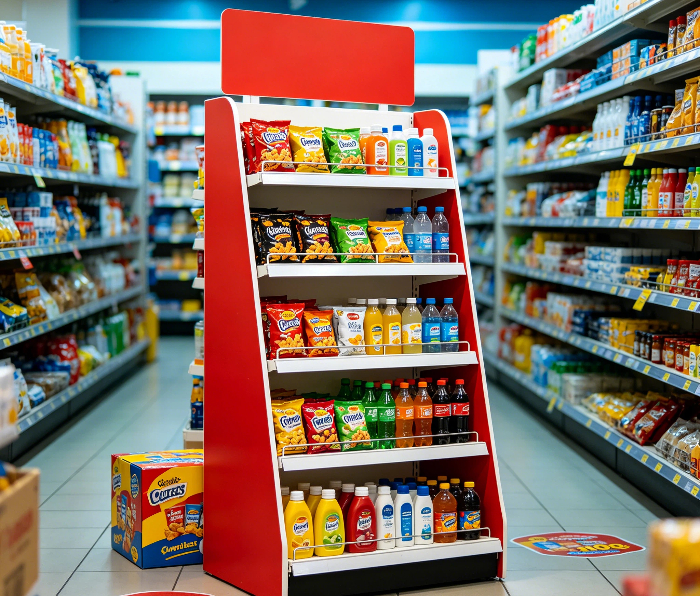
POP displays are retail marketing tools used to showcase products and attract customer attention at the point of purchase. They help increase product visibility and encourage sales in stores, supermarkets, and other retail environments.
Standard POP displays are ready-made solutions with fixed designs and sizes. They are cost-effective, easy to deploy, and suitable for short-term promotions. Custom POP displays are designed specifically for a brand, allowing businesses to customize the structure, materials, colors, ad graphics to create a unique shopping experience and strengthen brand recognition.
Choosing between the two depends on factors such as budget, marketing goals, and the level of brand customization required.
Brand visibility is one of the most important factors in retail marketing because it directly affects how quickly customers notice, understand, and trust a product. In crowded retail environments, a strong visual presence can significantly increase product engagement and sales performance.
Standard POP displays are pre-designed structures with fixed sizes and layouts. They are mainly used for fast deployment and low-cost promotions. While they can effectively hold and present products, their visual design is often generic, which limits a brand’s ability to stand out. In highly competitive shelves, standard displays may blend into the background and fail to create a strong brand impression.
Custom POP displays are designed specifically around a brand’s identity and marketing goals. They allow full customization of structure, materials, colors, lighting, and graphics. This flexibility helps brands create eye-catching retail presentations that immediately attract customer attention and communicate brand value more effectively.
In most retail scenarios, custom POP displays deliver a stronger visual and emotional impact. They not only enhance product visibility but also strengthen brand recognition and customer recall. Standard displays, while cost-efficient and practical, are better suited for short-term or low-priority promotions where branding is less critical.
If the goal is long-term brand building and stronger shelf presence, custom POP displays are the more effective choice. Standard POP displays remain a good option for budget-sensitive or temporary campaigns.
Cost, production speed, and design flexibility are key considerations when selecting between custom and standard POP displays. Each option serves different marketing needs and budget levels.
Standard POP displays are more economical because they use existing designs and are produced in bulk. This helps reduce unit cost and makes them suitable for short-term or price-sensitive campaigns. Custom POP displays require additional investment in design, tooling, and production setup, but they often deliver stronger branding value and better long-term returns.
Standard displays can be produced and shipped quickly since the structure is already defined. This makes them ideal for urgent promotions or fast retail rollouts. Custom POP displays need a longer production cycle, including design confirmation and sampling, but the final result is more aligned with specific product and brand requirements.
Standard solutions offer limited customization, mainly restricted to minor adjustments such as printing or color changes. In contrast, custom POP displays provide full flexibility in structure, materials, dimensions, and visual design, allowing brands to create a more distinctive in-store presence.
If speed and budget are the priority, standard POP displays are a practical choice. If the goal is stronger branding, better product presentation, and long-term retail impact, custom POP displays are the more strategic option.
Custom POP displays are widely used in industries where product presentation and brand visibility directly impact purchase decisions. They are especially valuable in retail environments with high competition and strong reliance on visual merchandising to attract customers.
Cosmetics and beauty brands use custom POP displays to enhance product appeal through packaging presentation, color coordination, and brand storytelling. In the food and beverage sector, as well as other fast-moving consumer goods, these displays are commonly used to promote seasonal items, new product launches, and impulse-buy products in supermarkets and convenience stores.
In the electronics industry, custom POP displays help organize products clearly while highlighting technical features and brand identity. Health and pharmaceutical products use them to improve product trust and communication of benefits. In fashion and luxury retail, custom displays are often designed with premium materials and refined structures to reinforce brand positioning and enhance the in-store experience.
Industries with strong competition and high brand awareness needs benefit the most from custom POP displays, as they improve visibility, support product differentiation, and increase retail conversion rates.
Choosing between custom and standard POP displays is not just a cost comparison. It usually comes down to how the display will perform in a real retail environment and what role it plays in your overall marketing strategy.
Budget is often the starting point. Standard POP displays are more economical because they are produced in bulk with fixed structures, making them suitable for short-term promotions or price-sensitive campaigns. Custom POP displays, on the other hand, require additional investment in design and tooling, but they are built to support stronger branding and long-term retail presence.
Brand positioning also plays a key role in the decision. If a product needs to stand out on a crowded shelf or support a new product launch, custom displays offer more flexibility in structure, materials, and visual design. This allows brands to create a more memorable in-store experience. Standard displays are more limited in this aspect but still work well for simple product placement or temporary campaigns.
Another important factor is timing. Standard displays can be produced and delivered quickly, which is useful for urgent retail needs. Custom solutions require more time for design, approval, and production, so they are better suited for planned campaigns rather than last-minute promotions.
In practice, the decision usually depends on balancing cost efficiency with marketing impact. Brands focused on visibility and differentiation tend to choose custom POP displays, while those prioritizing speed and budget control often lean toward standard options.
Choosing the right POP display solution is ultimately about matching your product, brand goals, and retail environment rather than simply selecting a design. There is no one-size-fits-all option—what works for a high-end brand launch may not be suitable for a fast-moving promotional campaign.
Before making a decision, it is important to consider where the display will be used, how long it needs to last, and what kind of customer attention you want to achieve. If the focus is short-term visibility and quick rollout, a standard POP display can be a practical choice. If the goal is stronger brand impact and better in-store differentiation, a custom solution is often more effective.
In many cases, the best approach is to balance cost with marketing value. A well-chosen POP display should not only fit your budget but also support product visibility and reinforce brand identity in a competitive retail space.
Q1: What is the main difference between custom and standard POP displays?
Custom POP displays are designed specifically for a brand with flexible structure and branding elements, while standard displays use fixed designs and are mass-produced.
Q2: Which one is more cost-effective?
Standard POP displays are more cost-effective due to bulk production and fixed designs. Custom POP displays require higher initial investment but offer stronger branding value.
Q3: When should I choose a custom POP display?
Custom POP displays are ideal when you need strong brand visibility, product differentiation, or support for new product launches.
Q4: When is a standard POP display a better choice?
Standard displays are better for short-term promotions, limited budgets, or fast retail rollouts where customization is not required.


3/F No. 6 Hedi Road, Gongming Street, Guangming District, Shenzhen City, GD, China, 518106


