
A POP display can look great in a product photo and still fail inside a real store.
That usually happens when the display type does not match the product, the store location, or the way shoppers actually buy. A countertop display may work beautifully for lip balm or nail polish, but it will not solve the same problem as a pallet display built for high-volume beverage promotions. A sidekick display can create an extra selling point beside a shelf, but it should not be treated like a small floor display. Each format has its own job.
That is why choosing the right type of POP Displays matters.
POP displays, also known as point of purchase displays, are designed to create extra visibility near the buying decision. They help brands present products outside ordinary shelf space, support promotions, organize SKUs, and make products easier for shoppers to notice and buy.
But there is no universal display that works for every product. The right choice depends on product size, product weight, retail environment, campaign length, shipping method, store rules, and how shoppers interact with the product.
Below are seven common types of POP displays and what they are best used for.
POP Displays are retail display structures placed near the point where shoppers make purchase decisions. They may appear on counters, at aisle ends, beside shelves, on pallets, in promotional zones, or directly inside product categories.
A standard shelf stores products. A POP display actively presents them.
This is the key difference. A shelf often depends on shoppers already looking for the category. A POP display creates a separate visual moment. It can highlight a new product, promote a seasonal offer, support impulse purchases, or give a brand more space than regular shelving allows.
You will see POP displays used for snacks, beverages, cosmetics, personal care, pet products, electronics accessories, pharmacy items, gift sets, and many other retail categories.
The display type affects more than appearance.
It decides how much inventory the display can hold, how shoppers approach the product, how staff refill it, how the unit ships, how much space it occupies, and whether it fits store rules. A good display type supports both marketing and retail execution.
Before choosing a display, brands should ask a few practical questions:
How large and heavy is the product?
Where will the display be placed?
Is the campaign temporary or long-term?
Does the display need to ship flat or pre-filled?
Will store staff assemble it?
How often will products be restocked?
Once these questions are clear, the differences between display types become much easier to understand.
Floor displays are freestanding display units placed directly on the retail floor. They are commonly used in supermarkets, pharmacies, convenience stores, beauty stores, pet stores, and promotional areas where brands need stronger visibility than regular shelf placement can offer.
A floor display works well when a product needs its own space. It can hold multiple SKUs, support larger graphics, and create a branded presentation away from the crowded shelf.
Common uses include beverage promotions, snack launches, cosmetic campaigns, pet product displays, seasonal gift sets, and personal care products.
Floor displays can be made from cardboard, PVC, acrylic, metal, wood, or mixed materials. The material choice depends on product weight, campaign duration, and brand positioning.
Floor displays are useful when a product needs to stand out in a high-traffic area. They are also a good option when a brand wants to display a complete product line instead of only one SKU.
However, they are not always the best answer. If the product is very heavy, the structure needs reinforcement. If the store has limited floor space, a sidekick, endcap, or shelf display may be more practical. A cardboard floor display can work well for short-term campaigns, but it may not be suitable for long-term use with frequent replenishment.
A floor display should be visible, stable, easy to shop, and realistic for the store environment.
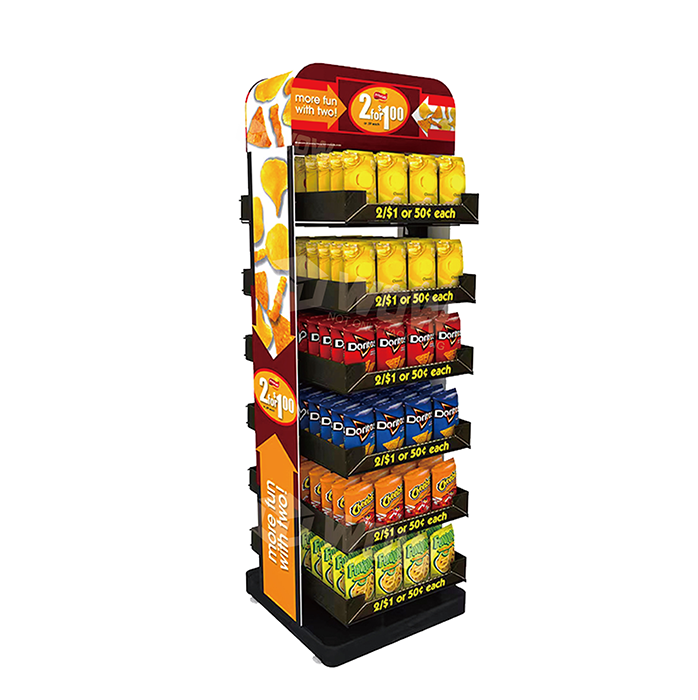
Countertop displays are small POP displays placed on checkout counters, service desks, beauty counters, pharmacy counters, or display tables. They are built for close-range selling.
This format is ideal for small products that shoppers can understand quickly. Think lip balm, gum, candy, nail polish, skincare samples, small cosmetics, phone accessories, travel-size products, and small packaged goods.
The power of a countertop display comes from timing. Shoppers are often already near the final buying moment. If the product feels useful, affordable, and easy to pick up, it can become a simple add-on purchase.
Countertop displays work best for lightweight products, samples, testers, and low-friction purchases. They are especially useful in beauty retail, pharmacy counters, convenience stores, and checkout areas.
The design should stay compact. If the display is too tall, too crowded, or hard to restock, store staff may move it aside. Counter space is working space, so the display should not block payment devices, staff movement, or customer interaction.
For small products, a countertop display can be more effective than a larger fixture hidden deeper in the store.
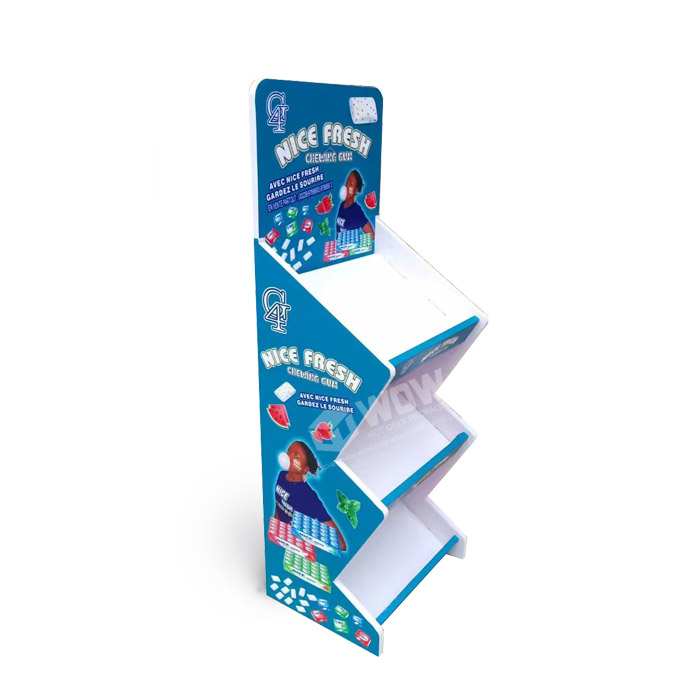
Pallet displays are large retail displays built on or around a pallet base. They are commonly used in supermarkets, club stores, warehouse stores, and big-box retail environments.
These displays are designed for high-volume products. They can hold large quantities of stock and are often used for beverages, bulk snacks, household goods, seasonal products, paper goods, and large packaged items.
Unlike ordinary floor displays, pallet displays are not just about visual presence. They are also about logistics. They need to handle loading, transportation, forklift movement, store placement, and fast replenishment.
Pallet displays are a strong choice when product volume is high and store space allows a larger footprint. They work well for fast-moving promotions, seasonal stock-up campaigns, and products sold in cases or multi-packs.
The structure must be stable. Product weight, pallet size, bottom support, side protection, and carton loading should be considered early. If the display looks impressive but is difficult to move, unsafe when loaded, or hard to replenish, it will cause problems in-store.
For heavy or high-volume retail programs, pallet displays can be one of the most practical POP display solutions.
Endcap displays are placed at the end of store aisles. This position is valuable because it faces shopper traffic and gives products visibility outside the regular shelf run.
Retailers often use endcaps for promotional products, seasonal offers, new launches, category features, or cross-merchandising. A coffee brand might use an endcap to highlight a new flavor. A skincare brand might use one near a pharmacy aisle. A snack brand might use it for a limited-time promotion.
Endcap displays are effective because they sit where shoppers naturally pass, even if they were not planning to enter that aisle.
Endcap displays work best when a brand has access to aisle-end space and needs to create a focused retail feature. They are good for category campaigns, supermarket promotions, cross-selling, and seasonal product pushes.
The key is location. An endcap is not simply a freestanding display placed anywhere. Its value comes from the aisle-end position.
The design should make the product and offer clear from a short distance. Too many SKUs or too much text can weaken the impact. Endcaps work best when the shopper understands the product story quickly.
Sidekick displays, also called power wing displays, are usually attached to the side of a shelf or endcap. They are smaller than floor displays and take up little or no floor space.
They are often used for lightweight packaged products, add-on items, trial packs, small accessories, candy, batteries, personal care products, pet treats, and small beauty items.
A sidekick display is useful when a brand wants extra visibility without needing a full floor display. It can place a product beside a related category and encourage cross-selling.
Sidekick displays work well for impulse purchases and small packaged products. For example, a battery display near electronics, a candy pack near checkout, or a pet treat display near pet food can all make sense.
The main advantage is placement. A sidekick display can interrupt the shopper’s path without taking over the aisle.
Still, it has limits. It should not carry products that are too heavy or bulky. It also needs to stay balanced and secure when products are removed unevenly. For sidekick displays, the structure may be small, but the stability still matters.
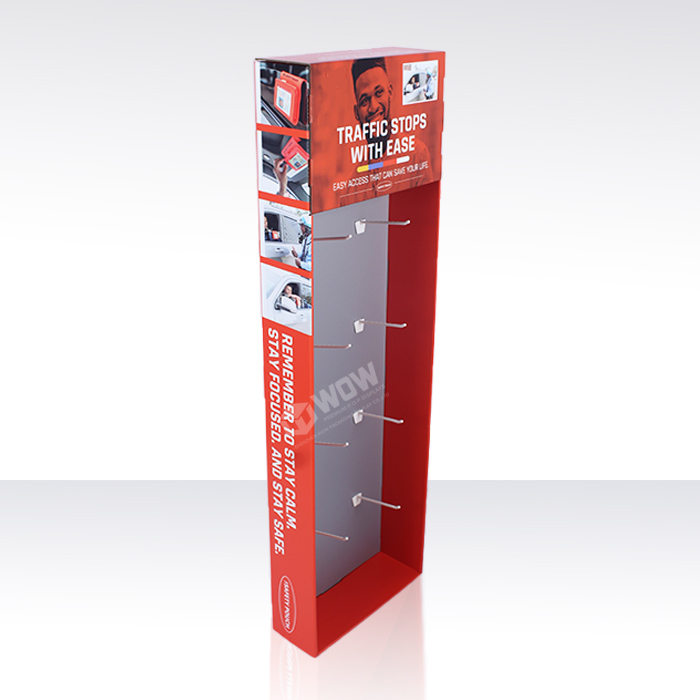
Dump bins are open container-style displays that allow shoppers to browse or pick products directly from the bin. They are common in supermarkets, discount stores, toy stores, convenience stores, and seasonal retail areas.
They work well for low-cost, high-volume, easy-to-grab products such as snack bags, toys, socks, small packaged goods, seasonal items, and clearance products.
Dump bins are designed to create a sense of abundance. They are not meant to look highly structured like a premium acrylic display. Their strength is simple access and volume.
Dump bins work best for promotions where shoppers do not need much product explanation. The product should be easy to recognize, easy to pick up, and often price-driven.
That said, a dump bin should not look chaotic. A full bin can feel attractive, but a messy bin with unclear pricing or mixed products can become visual noise.
Good dump bin design should consider height, product visibility, pricing panels, replenishment, and how the display looks after shoppers have taken products throughout the day.
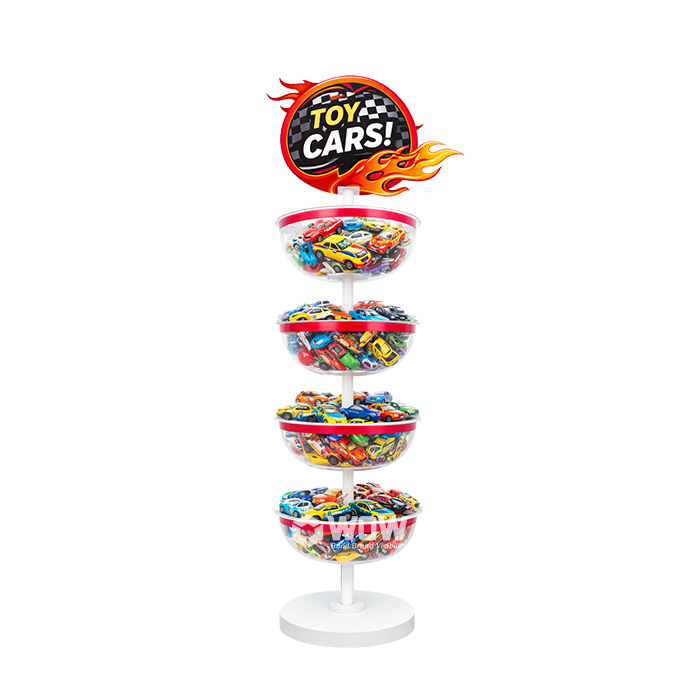
PDQ trays and shelf displays are small retail display formats designed for quick setup. Many are used on shelves, counters, checkout areas, or category displays.
They are often used for candy, samples, small cosmetics, pharmacy products, trial packs, and lightweight accessories. In many cases, the shipping carton can also become the display tray, which helps stores set up products quickly.
PDQ trays are useful when brands need a simple, low-cost, and repeatable display solution across multiple stores.
PDQ trays work best for small packaged products and retail programs that need fast placement. They are also useful for products that need shelf-level organization but do not require a large standalone display.
Their main value is efficiency. They reduce setup time, keep products grouped, and help stores present items with less handling.
The limitation is scale. A PDQ tray cannot create the same visual impact as a floor display or endcap. It works best when the product already benefits from shelf or counter placement.
Product size and weight should come first.
Small and lightweight products often fit countertop displays, sidekick displays, or PDQ trays. Medium-sized products may work well on floor displays or endcaps. Heavy or high-volume products usually require pallet displays, dump bins, or reinforced floor displays.
This sounds basic, but it is one of the most common mistakes in POP display planning. A display that looks good in concept may fail if the shelf strength, base stability, or product loading is not considered early.
The store location should guide the display format.
A checkout counter favors countertop displays or PDQ trays. An aisle end favors endcap displays. A big-box store aisle may need pallet displays. Shelf-side space works well for sidekick displays. Open promotional zones are better for floor displays. Clearance or high-volume seasonal areas may suit dump bins.
A strong POP display does not only fit the product. It fits the place where the product will be sold.
Campaign duration also matters.
Short-term promotions often use cardboard or corrugated materials because they are cost-efficient, printable, and easy to ship. Semi-permanent displays may use PVC, acrylic, or metal combinations. Long-term retail displays often need metal, wood, acrylic, or engineered mixed-material structures.
Material choice should match the display’s real job. A temporary campaign does not always need a permanent structure. A long-term display should not rely on materials that cannot handle daily use.
A display is not finished when the design looks good.
It still needs to be packed, shipped, assembled, loaded, and restocked. Store staff may not have tools. Multi-store rollouts may require flat-pack packaging, clear instructions, pre-filled options, or carton sizes that match distribution needs.
Restocking also matters. A display should still look organized after some products are sold. If the structure collapses visually after partial sell-through, the display will not perform well throughout the campaign.
A display should look good, but appearance alone is not enough.
Brands sometimes choose a display because the rendering looks impressive. But in-store, the real questions are different: Can it hold the product? Can shoppers reach the item? Can staff restock it? Can it ship safely? Will the store accept the footprint?
A strong POP display needs both visual impact and retail logic.
Not every structure can handle every product.
A lightweight cardboard counter display may be perfect for cosmetics or candy, but not for heavy glass bottles. A small sidekick display may work for trial packs, but not for bulky products. Pallet displays, reinforced floor displays, or metal structures may be needed for heavier items.
Weight, balance, and product loading should never be treated as afterthoughts.
Retail stores often have rules for display size, aisle space, pallet dimensions, safety, and placement. If these limits are ignored, the display may be rejected, moved, or used in a weaker location.
Before production, brands should confirm where the display will be placed and what restrictions apply. This is especially important for endcaps, pallet displays, sidekick displays, and large floor displays.
FAQ
1.What are the main types of POP Displays?
The main types include floor displays, countertop displays, pallet displays, endcap displays, sidekick displays, dump bins, and PDQ trays or shelf displays. Each type is designed for a different retail location, product size, and campaign goal.
2.Which POP display type is best for small products?
Small products usually work well with countertop displays, sidekick displays, and PDQ trays. The best choice depends on whether the product should be placed near checkout, beside a shelf, or inside an existing retail category.
3.Which POP display works best for supermarkets?
Supermarkets commonly use floor displays, endcap displays, pallet displays, dump bins, and sidekick displays. The right choice depends on product weight, stock volume, store location, and whether the campaign is short-term or long-term.
4.Are cardboard POP Displays strong enough?
Cardboard POP Displays can be strong enough for short-term promotions and medium-light products when the structure is designed properly. For heavier products, reinforced corrugated board, internal supports, or mixed-material structures may be needed.
5.Can POP Displays be customized for different products?
Yes. Custom POP displays can be designed around product size, weight, SKU count, branding, materials, packing method, store location, and rollout requirements.
Conclusion
The best POP display is not always the largest or the most expensive one.
It is the one that fits the product, the shopper, the store location, and the retail program. A countertop display may be perfect for small beauty items. A pallet display may be the right choice for high-volume beverages. A sidekick display may support add-on sales. A dump bin may work for seasonal promotions. A PDQ tray may help stores set up quickly.
Each type has a purpose.
For brands, the real value comes from choosing the format that makes the product easier to notice, easier to shop, easier to restock, and easier to roll out across stores.
Planning a retail display project? Talk to our team about custom POP Displays designed around your product, brand, materials, and store rollout needs.


3/F No. 6 Hedi Road, Gongming Street, Guangming District, Shenzhen City, GD, China, 518106


