
The counter is one of the few places in a store where the shopper has already slowed down.
They may be waiting to pay, asking a staff member a question, comparing small items, or standing close enough to touch a product without walking into another aisle. That short pause is easy to overlook, but in retail, it can be valuable.
This is where Countertop Display Stands do their real work.
They are not large fixtures. They do not dominate a store like floor displays or endcap displays. Their value comes from something different: they appear close to the shopper, close to the payment area, and close to the final moment when one more small purchase still feels easy.
A well-designed counter display can turn a small product into a quick add-on purchase. Lip balm, chewing gum, candy, skincare samples, phone accessories, keychains, perfume testers, small cosmetics, and travel-size products all fit this type of retail behavior.
But not every small product belongs on a counter. And not every counter display works just because it is placed near checkout. The product, structure, message, material, placement, and store execution all need to fit together.
That is what this article explains.
Placed at the Final Buying Moment
Countertop Display Stands are small retail display fixtures placed on checkout counters, service counters, pharmacy desks, cosmetics counters, display tables, boutique cashier areas, or other close-contact retail surfaces.
They are often used as point of purchase displays because they appear near the final stage of the shopping journey. The shopper is already in a buying mindset, which makes the counter different from the main shelf.
A shelf asks the customer to search.
A counter display puts the product directly in front of them.
That difference matters. A countertop display does not need to lead the shopper across the store. It only needs to make a product easy to notice, understand, and pick up during a short buying moment.
Built for Close-Range Product Visibility
Compared with larger retail fixtures, countertop displays work at close range. The shopper is usually standing near the display, so the product does not need to compete from far away. Instead, it needs to be immediately clear.
A good counter display unit should answer three questions almost at once:
What is the product?
Why should I notice it?
Can I pick it up easily?
If the display cannot answer those questions fast, the shopper will likely move on.
Different From Floor Displays and Shelf Displays
A floor display is often built for strong visual impact from a distance. A shelf display works inside an existing product category. A countertop display is different.
It has less space, but it appears closer to the final decision point. That means clarity matters more than scale.
The product needs to be visible.
The message needs to be quick.
The item needs to be easy to take without disturbing the whole display.
A counter display is not just a small tray with products inside. It is a micro-selling space.
Small Products That Are Easy to Understand
The strongest fit is usually a product that is small, easy to understand, and easy to add to an existing purchase.
Candy, gum, lip balm, mini skincare, travel-size products, gift cards, keychains, sample packs, and small packaged goods all fit this pattern. Shoppers do not need several minutes to understand them. The product use is obvious, the price is usually manageable, and the decision feels light.
These products do not need a large fixture. They need visibility at the right moment.
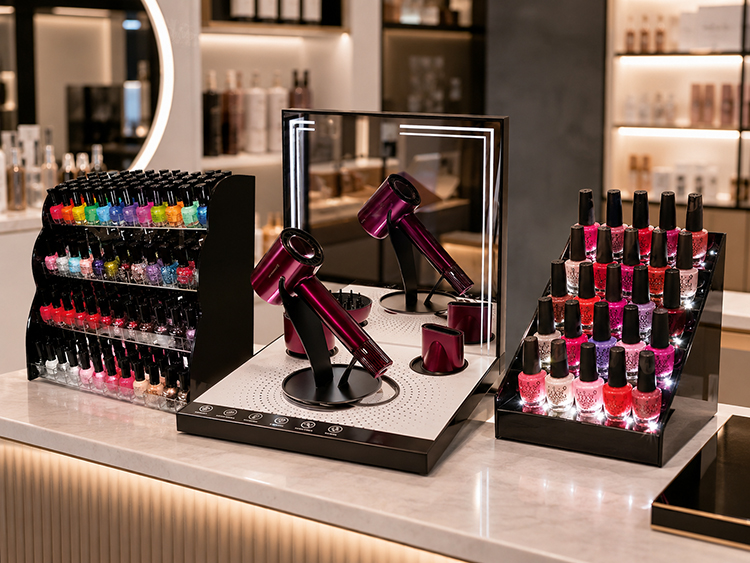
Beauty and Personal Care Items
Beauty and personal care products can also perform well on retail countertop displays, especially when shoppers benefit from close viewing or light interaction.
A nail polish display, perfume tester stand, cosmetics tray, or skincare sample unit can make the product feel more accessible than it would inside a locked cabinet or crowded shelf.
For these products, the display should not only hold inventory. It should help shoppers see colors, textures, packaging, or sample options clearly.
Small Electronics Accessories and Practical Add-Ons
Small electronics accessories are another common category.
Charging cables, adapters, screen cleaners, small cases, earbuds, and compact tech accessories are practical add-ons. A shopper may remember they need one only when they see it.
For these items, organization is important. Hooks, trays, dividers, or small compartments can make different SKUs easier to compare. A messy pile of cables or accessories will weaken the display quickly.
Products That May Not Fit Counter Displays
Not every product belongs on a counter.
Large items, expensive products requiring detailed explanation, heavy goods, or products with complex variations may need a different display format. In those cases, a floor display, shelf display, locked showcase, or guided product presentation may be more suitable.
The key question is simple: can the shopper understand the product quickly and pick it up easily?
If yes, a countertop display stand may be a strong option.
The checkout counter is not the same as the main shelf.
By the time shoppers reach the counter, they have already made most of their planned purchases. They may be waiting to pay, looking around while staff scan items, or standing close enough to notice small products nearby.
This creates a short decision window.
A countertop display works well when it fits into that moment. The shopper is not starting a long product search. They are making a quick judgment:
Is this useful?
Is it affordable?
Is it easy to pick up?
Do I want to add it now?
The display does not need to create a full shopping journey. It only needs to make one extra purchase feel simple.
The Product Must Be Easy to Say Yes To
The best products for countertop displays are usually easy to understand without staff explanation.
A pack of gum, a lip balm, a small skincare sample, a keychain, a phone cable, or a travel-size product does not require a long decision process. The shopper can understand the use quickly.
Price also matters. If the product feels like a low-risk add-on, the buying decision becomes easier. If the price is high or the product requires comparison, the counter may not be the right location.
This is why brands should not choose counter display products only based on what they want to push. They should choose products that shoppers can accept quickly in that exact retail moment.
The Message Should Be Clear Before Payment Is Finished
A counter display has very little time to communicate.
The message needs to be simple: what the product is, why it is useful, and why the shopper should pick it up now. Long copy, too many claims, or too many product options can weaken the effect.
For promotional products, the offer should be visible. For beauty items, the color or product benefit should be easy to see. For small accessories, the product function should be obvious.
A good checkout counter display does not ask the shopper to think too much.
It removes friction.
Tiered Trays for Cosmetics and Small Packaged Goods
Tiered trays are useful when products need to be seen from the front.
For cosmetics, skincare, lip balm, perfume samples, nail polish, and small packaged goods, a tiered structure helps keep products organized without hiding the back row. It also creates a cleaner view when customers stand close to the counter.
This format works best when SKU quantity is controlled. If too many colors, scents, or sizes are squeezed into one small tray, the display can quickly become confusing.
A good tiered counter display should make comparison easier, not harder.
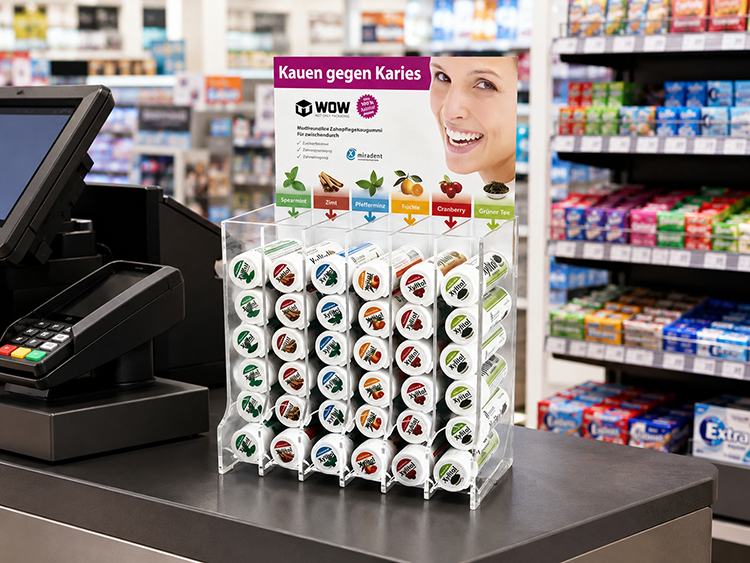
Gravity Feed Displays for Candy, Gum, and Small Packs
Gravity feed displays are often used for small packaged products that sell quickly, such as gum, candy, mints, sachets, and snack packs.
The advantage is simple: products move forward as customers take them. This helps the display stay full-looking without constant manual adjustment.
For high-turnover counter products, this matters. A display that looks empty or messy after a few purchases can lose impact quickly.
This format is practical, but it needs accurate product sizing. If the pack is too wide, too light, or too irregular, the product may not slide properly.
Hook and Peg Displays for Accessories
Hook or peg displays are better for small hanging products.
Phone accessories, keychains, small tools, packaged cosmetics, hair accessories, and lightweight retail add-ons often work well with hooks. This structure keeps the counter surface cleaner and makes different SKUs easier to separate.
However, hook displays need careful balance. If the display is too narrow or too tall, it can become unstable when products are removed unevenly.
For counter use, stability should never be an afterthought.
Tester and Sample Displays for Beauty Counters
Beauty counters often need a different kind of countertop display.
The purpose is not always immediate impulse buying. Sometimes the goal is trial, comparison, and product experience. A tester display for skincare, perfume, cosmetics, or nail products should make the product easy to touch, test, and understand.
In this case, material finish becomes more important. Acrylic, metal, wood, or mixed-material structures can create a cleaner and more premium presentation than a simple cardboard tray.
For beauty products, the counter display becomes part of the brand experience, not just a product holder.
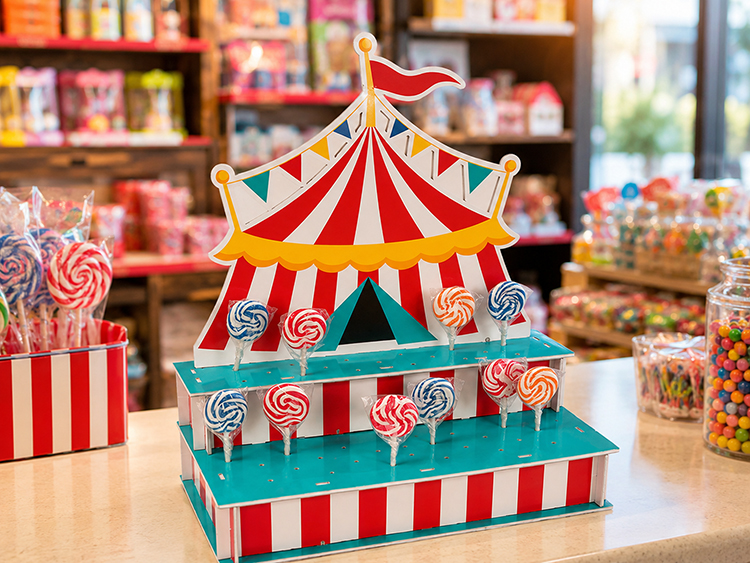
Cardboard counter displays are practical for short-term promotions. They are lightweight, printable, and cost-efficient for seasonal campaigns, snacks, candy, gum, and small packaged goods.
Their biggest advantage is visual flexibility. Printed graphics can cover the header, side panels, front lip, and product area, making the display suitable for promotional messages.
The limitation is durability. If the display will be handled heavily or used for a long period, edges may wear and the structure may lose its clean look.
Acrylic counter displays are often chosen for products that need visibility and a cleaner presentation.
Cosmetics, skincare, watches, jewelry, small electronics, and premium accessories often benefit from acrylic because the material feels light, clear, and modern. It allows the product to stay visible without visually overwhelming it.
The trade-off is cost and surface care. Acrylic can scratch if handled roughly, so finishing, packing, and daily use should be considered.
PVC can be a useful middle option.
It is more durable than cardboard and often more cost-controlled than acrylic. It works well for medium-term counter displays, especially when brands want a clean printed surface but do not need a transparent structure.
PVC is also flexible in production. It can be cut, shaped, printed, and assembled into different display formats.
It may not deliver the same premium clarity as acrylic, but for many retail counter programs, it offers a practical balance between appearance, cost, and durability.
Metal and wood are better suited for longer-term or more premium counter presentations.
Metal adds strength and can support repeated product handling. Wood creates warmth and a more permanent brand feeling. These materials work well for boutique counters, gift products, small premium goods, or long-term branded areas.
The downside is higher cost, heavier shipping, and less flexibility for short-term campaigns.
Many custom countertop display stands use mixed materials to balance function and appearance.
A display may use a metal frame for stability, acrylic holders for product visibility, and printed PVC or cardboard panels for branding. This approach allows brands to control where cost is spent and where visual impact matters most.
The best material choice is rarely about one material being “better.” It is about which combination fits the product and retail use.
Checkout Counters
The checkout counter is the most obvious location.
A checkout counter display works well when the product is low-friction and easy to add to the basket. Gum, candy, lip balm, travel packs, small tools, or phone accessories can benefit from that final purchase moment.
The display should be easy to see while the shopper waits or pays. It should not block payment terminals, bagging areas, or staff movement.
Cosmetics and Beauty Counters
Cosmetics counters are different.
Here, the shopper may be more willing to compare, touch, test, or ask questions. A countertop display in this space should support close viewing and product interaction, not just quick impulse buying.
For beauty products, presentation quality matters. Product angle, lighting, material finish, and tester access can all affect how professional the display feels.
Pharmacy and Service Counters
Pharmacy counters need a cleaner and more practical approach.
Products placed there should feel organized, useful, and trustworthy. Too much color or clutter can work against the category.
A good pharmacy counter display should help shoppers notice practical add-on products without making the space feel chaotic.
Boutique Cashier Areas
Boutique cashier areas can support small premium add-ons: jewelry, fragrance samples, small gifts, accessories, or branded items.
In these spaces, the display should feel consistent with the store style rather than looking like a temporary promotion. Material and finish become more important here.
Counter Space Is Operational Space
A retail counter is not empty display space.
It is a working area. Staff scan products, pack bags, answer questions, process payments, handle returns, and sometimes demonstrate products there. If a countertop display gets in the way, store staff may move it to a weaker position — even if the original design looked good.
A display should be visible to shoppers, but it should not block payment devices, receipt printers, barcode scanners, bags, samples, or staff movement. The footprint needs to be planned around the real counter, not just the product.
A display that interrupts store operation will not stay in the best location for long.
Restocking Should Be Fast and Obvious
Counter displays are often small, but they still need to be restocked.
If staff do not know where each product belongs, the display will become messy during the day. If products are hard to refill, staff may simply place them wherever there is space. Once that happens, the display loses its structure and brand presentation.
This is why product slots, trays, dividers, printed labels, or simple shelf logic can be useful.
A good counter display should make restocking almost automatic. Staff should understand the layout without needing instructions.
Partial Sell-Through Changes the Display Appearance
A counter display rarely stays perfectly full.
Customers pick up products. Some SKUs sell faster than others. Samples may be moved. Packaging may shift. After a few hours, the display can look very different from the approved product photo.
This is where structure matters.
A display should still look organized after partial sell-through. Products should not collapse into empty gaps. The strongest product message should remain visible even when stock level changes.
This is especially important for multi-SKU displays. If one product sells faster, the display should not suddenly look broken.
Packing and Multi-Store Rollout Matter
For one store, a display can be adjusted by hand.
For many stores, it needs to be repeatable.
Packing, assembly, and shipping become part of the display design. A countertop display may need to ship flat, arrive pre-filled, assemble without tools, or fit into a standard carton. If the packaging is not planned properly, displays can arrive damaged or take too long to set up.
This is why production thinking should start early.
A good counter display is not only designed for the customer. It is also designed for shipping, store staff, replenishment, and real daily use.
Using the Display as Product Storage
The most common mistake is using the counter display as storage.
A full display can look productive, but too many products can weaken the message. At counter level, clutter becomes obvious very quickly.
If the shopper cannot understand the offer in a few seconds, the display is doing too much.
Adding Too Many Products or Messages
Some brands try to include every SKU, every benefit, every flavor, and every promotional message in one small counter display.
That usually creates confusion.
A counter display should have a clear focus. One main product group, one main message, and one simple buying cue are often stronger than a crowded presentation.
Making Products Hard to Pick Up
Poor product access is another issue.
If items are hard to remove, customers avoid touching them. This is especially true for tightly packed cosmetics, small electronics accessories, or fragile items.
A product that cannot be easily picked up is less likely to be purchased.
Ignoring Packing, Shipping, and Store Setup
The final mistake is ignoring how the display will ship and arrive.
For multi-store promotions, packing efficiency matters. A display that looks good but arrives damaged, takes too long to assemble, or needs complicated setup may not work well at scale.
A good counter display has to survive more than a product photo. It has to survive retail.
FAQ
1.What are countertop display stands used for?
Countertop display stands are used to present small products, samples, promotional items, and add-on products on retail counters, checkout areas, cosmetics counters, pharmacy desks, and service counters.
2.Do countertop displays increase sales?
They can support sales by improving product visibility and encouraging last-minute or impulse purchases. The result depends on product type, placement, price point, message clarity, and how easy the product is to pick up.
3.What products work best on countertop display stands?
Small, easy-to-understand products usually work best. Examples include candy, gum, lip balm, skincare samples, cosmetics, phone accessories, keychains, gift items, travel-size products, and small packaged goods.
4.What materials are best for counter display units?
Cardboard is useful for short-term promotions, acrylic works well for premium visibility, PVC is suitable for durable medium-term use, and metal or wood can support stronger long-term brand presentation.
5.Can countertop display stands be customized?
Yes. Countertop display stands can be customized by product size, material, structure, branding, shelf layout, pickup method, packing style, and retail counter space.
6.How do I choose a countertop display stand for my product?
Start with the product size, weight, price point, retail location, campaign length, and shopper behavior. A good display should make the product easy to notice, understand, pick up, and restock.
Conclusion
A countertop display stand does not need to be large to be effective.
It needs to meet the shopper at the right moment, with the right product, in the right counter space. Product focus, message clarity, stable structure, easy pickup, material choice, and store operation all influence whether the display works.
For small products, the counter can be more than leftover retail space.
It can become a final selling point.
A strong countertop display helps shoppers notice one more item, understand it quickly, and add it to the purchase without hesitation. That is where small displays create real retail value.
Planning a counter promotion? Talk to our team about custom countertop display stands designed for product visibility, shopper interaction, and real retail execution.


3/F No. 6 Hedi Road, Gongming Street, Guangming District, Shenzhen City, GD, China, 518106


