
In retail, visibility is never guaranteed.
A product can be well made, competitively priced, and even supported by a strong promotion, yet still disappear in the store if nothing makes shoppers stop. That is where POP advertising becomes more than a supporting detail. It becomes the point where design, message, and selling pressure meet.
But here is the problem. Not every POP idea that looks creative actually works. Some displays are visually striking and still fail to communicate the product clearly. Others feel fresh for a moment, but leave shoppers confused about what they are supposed to notice or why they should care.
That is why creative thinking matters in POP advertising, but only when it is used in the right way. Good creative POP work is not about being unusual for its own sake. It is about making the product easier to notice, easier to understand, and harder to ignore.
Store environments are crowded by default. Shelves are packed. Promotions overlap. Packaging competes for attention. Shoppers are moving quickly, often without much patience for explanation.
In that kind of setting, ordinary visual language fades fast. A standard sign, a predictable shape, or a repeated promotional layout may still be visible, but it rarely creates a real pause. Creative POP advertising matters because it interrupts routine. It gives the shopper a reason to look again.
That is the first job of creativity in retail display design. It helps the display break through visual fatigue.
Still, attention is only the beginning. A POP display that gets noticed but fails to communicate clearly has only solved half the problem. That is why creativity in POP advertising cannot stop at visual novelty. It has to move beyond attention and support understanding.
This is where many retail displays go off track.
A POP concept may look clever in a presentation, or even feel exciting at first glance, but once it enters a real store, weaknesses become obvious. The message may be too abstract. The structure may compete with the product. The decorative elements may take over. The shopper sees the display, but not the selling point.
A display should not require too much decoding.
If shoppers need several seconds just to figure out what the display is trying to say, the communication is already under pressure. In-store decisions happen quickly. That means creative POP advertising has to simplify the message, not bury it.
This is a common mistake. Designers sometimes treat complexity as a sign of sophistication, but in retail, complexity often becomes friction. If the product benefit is unclear, or the promotional reason is hard to identify, the display may still look interesting while failing to do its actual job.
Another problem appears when the theme is not strong enough.
A POP display can include background graphics, props, shapes, characters, textures, and supporting visuals, but all of those elements have to serve one central idea. When they do not, the result becomes visually busy and thematically weak.
This matters more than people think. In POP advertising, the strongest creative idea is often not the most elaborate one. It is the one that makes the main message feel sharper. If the shopper remembers the styling but not the product, the creative balance is already off.
POP advertising can absolutely borrow from artistic thinking, but it is not pure art.
Art can afford ambiguity. Retail communication usually cannot. A POP display must work in a live shopping environment, close to the point of decision, where clarity matters more than interpretation. That difference changes how creativity should be used.
A display can be visually beautiful and still underperform if it does not support the product clearly enough. In retail, creativity is not judged only by visual originality. It is judged by whether it helps the display sell.
Once that is clear, the next step is easier. Instead of asking how to make a display more dramatic, the better question becomes: what kind of creativity makes POP more effective?
This is the core rule.
Creative POP advertising should make the selling message stronger, not more difficult to reach. A display is not successful because it looks different. It is successful because the difference helps the shopper understand something faster, remember something more clearly, or feel more motivated to act.
That is where many strong retail displays separate themselves from weaker ones. They do not add creativity on top of the message. They use creativity to shape the message.
A good POP concept should sharpen the theme.
If the display is built around freshness, indulgence, hydration, convenience, repair, or discovery, every visual choice should support that direction. The role of creative thinking is not to introduce a second story. It is to make the first story stronger.
This is especially important in stores, where attention is fragmented and decisions are fast. One strong theme usually performs better than several competing ideas placed side by side.
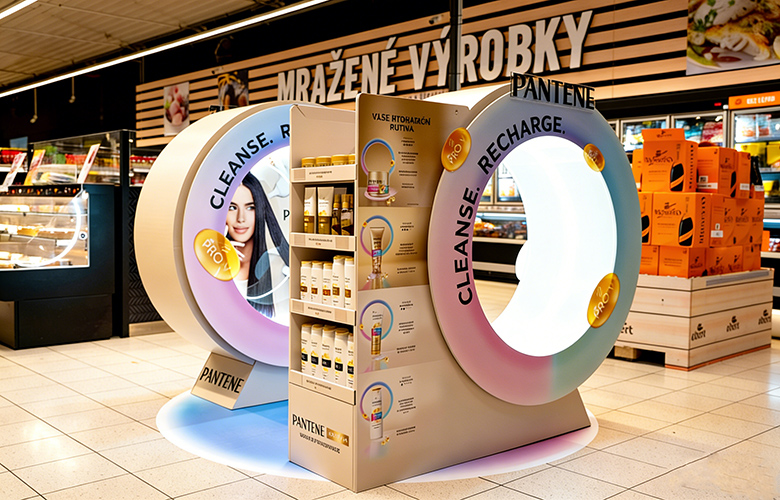
The Pantene display is a strong example of creative thinking that stays close to the brand message.
Instead of relying on loud price communication or dense promotional language, the display uses oversized circular illuminated forms to create a clean, ritual-like structure around the product. The words and product guidance remain present, but the larger emotional message is built through shape, light, and spatial framing. The display feels restorative, polished, and beauty-led before the shopper reads very much at all.
That is what makes this case useful. It shows how a POP display can build a mood while still reinforcing a clear product story. The design does not distract from the brand promise. It gives it a stronger physical form.
A lot of people still talk about creative inspiration as if it arrives by accident. That view sounds romantic, but it is not especially useful in real design work.
In practice, better POP ideas usually come from better combinations. Designers connect forms, meanings, product attributes, familiar references, emotional cues, and visual contrasts in ways that create something fresh. That means creative thinking can be trained. It can be structured. It can be improved through method, not only instinct.
And that is good news for retail projects, because it makes creativity more reliable.
Creative POP ideas are often treated as if they appear from nowhere. In reality, they usually come from recombining things that already exist.
A product benefit connects with a visual metaphor.
A familiar object gets linked to a new category.
A contrast gets exaggerated to create stopping power.
An abstract feeling becomes a physical form.
This is why creative thinking in POP advertising is less mysterious than it sounds. Better ideas come from better relationships between pieces of information. Once you understand that, creativity becomes something more practical. It becomes a process of choosing the right kind of connection.
That is exactly why some creative routes work especially well in retail display design.
Analogy works by making the unfamiliar feel familiar.
If a product benefit is hard to explain directly, analogy can make it easier to understand by connecting it to something the shopper already knows. This is especially useful when the product promise is abstract, such as freshness, softness, energy, lightness, or protection.
In POP advertising, analogy helps speed up recognition. Instead of reading a long explanation, the shopper understands through association.
Contrast works because it breaks expectation.
A visual clash, an unusual pairing, or a strong before-and-after difference can interrupt routine browsing very quickly. In a crowded store, that is powerful. It creates a pause. It forces attention.
But contrast only works when it is still tied to the product meaning. If the tension feels random, the display may still get noticed while becoming harder to trust.
This route is more direct.
Instead of relying mainly on surprise, it shows a relationship between problem and solution, or between use and result. That makes it especially effective for categories where the product benefit needs to feel practical, visible, or outcome-based.
In POP display design, cause-and-effect thinking helps the shopper understand not only what the product is, but why it deserves action.
Grafting creates a new idea by joining things that do not usually belong together.
This method is useful when a brand wants a stronger visual hook. The unfamiliar combination creates novelty, and novelty creates attention. It is one of the most memorable routes in POP advertising when used well.
The risk, of course, is that the display becomes strange without becoming meaningful. So the combination has to support the product theme, not replace it.
This is where creative POP becomes especially powerful.
A lot of product benefits are not naturally visible. Hydration, confidence, softness, refreshment, comfort, or vitality all live at the level of feeling. Form-and-meaning thinking helps turn those intangible qualities into visible design.
That makes it ideal for beauty, wellness, and lifestyle categories, where shoppers are often responding as much to perception as to function.
The strongest display ideas often use more than one creative route at the same time.
A single POP display may combine contrast, analogy, and symbolic meaning, all within one retail execution. That kind of layered thinking can make the result much more memorable. It also makes control more important. The more elements involved, the easier it becomes for the theme to drift.
So complexity should only grow when the message stays clear.
Knowing the methods is useful. Using them well is the harder part.
The best way to stay on track is to keep returning to a few practical questions during development.
Before thinking about shape, props, or styling, the core product message has to be clear. What does the display need to communicate first? Newness? Benefit? Flavor? Ritual? Urgency? Premium quality? If that is not settled early, the creative direction usually becomes scattered.
Once that message is clear, creative choices become more useful. They stop being decorative experiments and start becoming communication tools.
A retail display is not a slow-reading medium. If the theme only becomes clear after prolonged attention, it is already fighting against shopper behavior.
This is a useful creative test: if someone walks by and glances for two seconds, what do they understand?
Decorative elements should strengthen the core message, not compete with it. This sounds obvious, but it is one of the easiest things to lose in development. Once visual energy starts increasing, the design team often wants to add more. Sometimes the smarter move is the opposite.
Creative POP is not judged in isolation. It is judged in fluorescent aisles, near stacked packaging, among competing promotions, with shoppers moving quickly and staff needing to restock product.
That is why strong POP ideas have to survive reality. If the design works only in a mockup, it is not done yet.
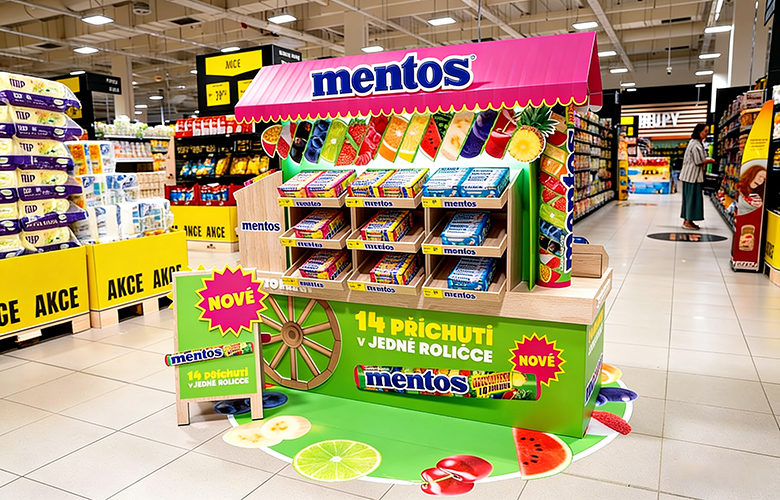
The Mentos display takes a different approach, and that contrast is useful.
Where the Pantene example builds atmosphere through form and light, the Mentos display works through playful retail familiarity. The structure resembles a small fruit stall, which immediately makes the multi-flavor concept easier to understand. The colors are bright, the setup feels cheerful, and the display creates a light, impulse-friendly mood without becoming difficult to shop.
That is what makes it effective. It is creative, but still practical. Shoppers can quickly understand the variety message, notice the “new” cue, and browse product without friction. The display feels imaginative, but not overdesigned.
This is a good reminder that creative POP does not always need to be dramatic. Sometimes it works best when it feels easy, clear, and instantly approachable.
Final Thoughts: Better POP Ideas Start With Better Creative Logic
Creative POP advertising is not about making things look unusual for the sake of it.
Its real value lies in making retail communication sharper. Better ideas help products get noticed, help messages land faster, and help shoppers move from curiosity to action with less friction. That is why the most effective POP displays are not simply eye-catching. They are structured, readable, and commercially intelligent.
The strongest creative work in POP advertising usually does one thing especially well: it turns innovation into clarity.
That is what gives a display lasting value in retail. Not novelty alone. Not decoration alone. But creative logic that helps the product sell.


3/F No. 6 Hedi Road, Gongming Street, Guangming District, Shenzhen City, GD, China, 518106


