
Walk into any supermarket, bottle shop, specialty store, or neighborhood retail space, and one thing becomes clear almost immediately: shoppers are surrounded by signals.
A hanging sign above an aisle.
A floor unit at the entrance.
A small card clipped to a shelf edge.
A branded block near the checkout.
A price panel that quietly pushes one item forward and lets another disappear.
That is store POP Display at work.
It is easy to underestimate this kind of retail communication because it feels ordinary. It is always there. It blends into the environment. But that is exactly why it matters. POP Display sits closer to the buying decision than almost any other form of marketing. It works when shoppers are already inside the store, already scanning options, already deciding what deserves attention.
And yet, a lot of store POP still misses the mark.
Some displays feel rushed. Some are too crude. Some are overloaded with messages. Some all look the same. They exist, but they do not really persuade. They fill space, but they do not shape decisions.
So the real question is not whether store POP Display matters. It clearly does. The more useful question is this: what separates effective POP from background noise?
At its core, store POP Display is on-site communication designed to influence shoppers near the point of purchase. It does not work at a distance like television, print, or outdoor media. It works in the moment, in the aisle, at the shelf, beside the product. That closeness is what gives it power.
A strong POP display does a few things at once.
First, it helps a product get noticed.
Second, it gives the shopper a reason to care.
Third, it makes the store feel more intentional.
That third point gets overlooked a lot. POP is not just about promoting one item. It also shapes the rhythm and visual tone of the retail environment. A well-managed POP system can make a store feel clearer, more active, more branded, more trustworthy. A weak one can do the opposite.
Retail spaces are crowded by default. Products compete with each other. Packaging competes with packaging. Promotions overlap. Good POP creates hierarchy. It tells the shopper where to look first.
Shoppers do not want to work too hard in-store. A useful POP display reduces friction. It points out the offer, the difference, the novelty, or the value without demanding too much mental effort.
Even when a shopper does not consciously study a display, they still absorb the overall impression. Clean, well-targeted POP can strengthen the sense that a store is organized and credible. Messy, low-quality POP can weaken it just as fast.
There is no single perfect way to classify POP Display, but in real store use, a few practical categories make the most sense.
POP can appear inside the store, outside the store, or in forms that work in both places. Indoor POP includes floor stands, shelf signs, hand-drawn promotional boards, counter displays, and product information cards. Outdoor POP includes storefront signs, hanging banners, decorative lighting, and entrance-level promotional materials. Some items, like brochures, leaflets, and price sheets, can move between both zones.
Store POP can be made from paperboard, wood, metal, plastic,or digital media. Each material carries a different message. Paper often feels promotional and flexible. Wood and metal can feel more stable or premium. Digital systems feel modern and dynamic, but they also need the right context to work well.
Some POP is made for a short promotion. Some is meant to stay through a season. Some becomes part of the store’s longer-term visual structure. That difference matters. A temporary unit does not need the same design language or material logic as a long-term branded display.
Freestanding stand, hook display, sidekick/powerwing displays, rotating display, shelf-edge cards, and counter displays all serve different roles. Some are built to stop traffic. Some are built to explain. Some are there to support impulse purchases. Good POP planning begins when those roles are treated differently, not lumped together.
This is where the conversation gets more practical.
POP is common, but strong POP is still less common than it should be. The original article identifies three recurring problems: weak unity between content and form, weak attention to customer demand levels, and weak innovation. Those three points still feel very relevant.
Some POP looks careless. Some looks too busy. Both create problems.
A rough handwritten clearance sign may be direct, but it can also feel cheap or untrustworthy. On the other hand, a heavily decorated display with too many colors, too many visual tricks, or too much copy may overwhelm the shopper before the message lands. The issue is not whether POP should be simple or dramatic. The issue is whether the form actually helps the message.
When content and presentation drift apart, the display starts working against itself.
Not all shoppers buy for the same reasons. Some respond to savings first. Some respond to quality. Some look for convenience. Some care more about atmosphere, brand image, or product identity. POP Display becomes weak when it ignores those differences and speaks to everyone in exactly the same voice.
That is where a lot of retail displays lose precision. They are visible, but not specific. They exist, but they do not feel aimed at the right person.
One store says “Clearance.” The next says the same thing. One says “Last 3 Days.” The next copies that too. After a while, these messages stop feeling urgent. They just become part of the wallpaper.
That is what weak innovation looks like in retail. Not dramatic failure. Just slow invisibility. The display is there, but it no longer earns attention because shoppers have seen the exact same language too many times before.
A better POP display does not necessarily shout louder. Usually, it communicates more clearly and feels more deliberate.
That means a few things.
It should look like it belongs to the product.
It should feel like it belongs to the store.
And it should speak in a way the intended customer actually responds to.
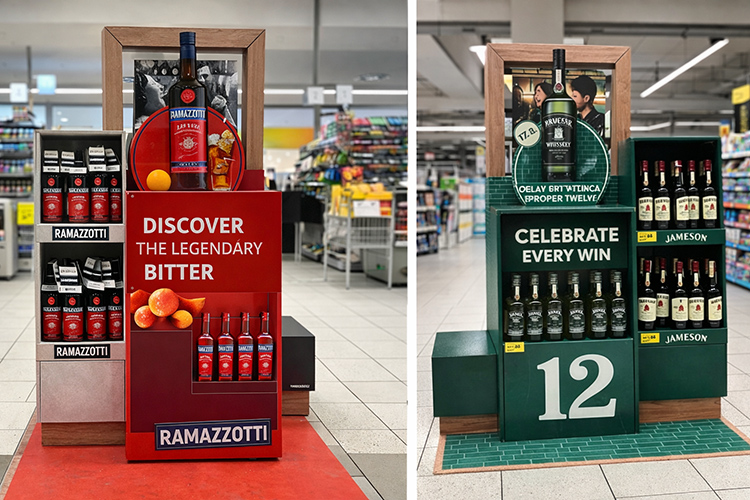
The Ramazzotti and Jameson displays are a good example of that balance. They are obviously promotional, but they do not blur into each other. One leans into a darker, more classic mood. The other uses a bolder, cleaner, more graphic structure. Both displays still read quickly in-store, which is the important part. They are distinctive without becoming confusing. That is usually where better POP starts.
Shoppers should not have to decode the display. A strong POP piece usually gives one central message priority and lets everything else support it.
A premium brand should not talk like a bargain bin. A price-led promotion should not hide the actual value point behind vague design language. Effective POP feels appropriate to both the product and the audience.
Innovation matters, but not for its own sake. A display should feel memorable because it sharpens the theme, not because it throws random visual energy into the space.
Once the basic mistakes are visible, the direction forward becomes easier to define.
The source article points toward three improvement areas: stronger unity between content and form, stronger attention to customer demand differences, and stronger innovation. That is still a solid framework.
A POP display should not force a choice between useful information and attractive presentation. It needs both. If the message is right but the display feels careless, trust drops. If the display looks polished but the message is unclear, conversion drops. Good retail POP keeps both working together.
Different shoppers respond to different cues. A higher-end customer often needs more emphasis on quality, atmosphere, and brand confidence. A more price-sensitive customer usually wants the value signal to be immediate and unmistakable. That does not mean one group matters more than the other. It just means POP has to speak in the right tone for the right audience.
Innovation in store POP should highlight product identity, not bury it. The article makes an important point here: stronger POP begins with a clear theme and a more concentrated message. That is still true. The best retail displays often feel more focused, not more crowded.
Sometimes a POP display does more than support one shelf or one message. It creates a retail moment.
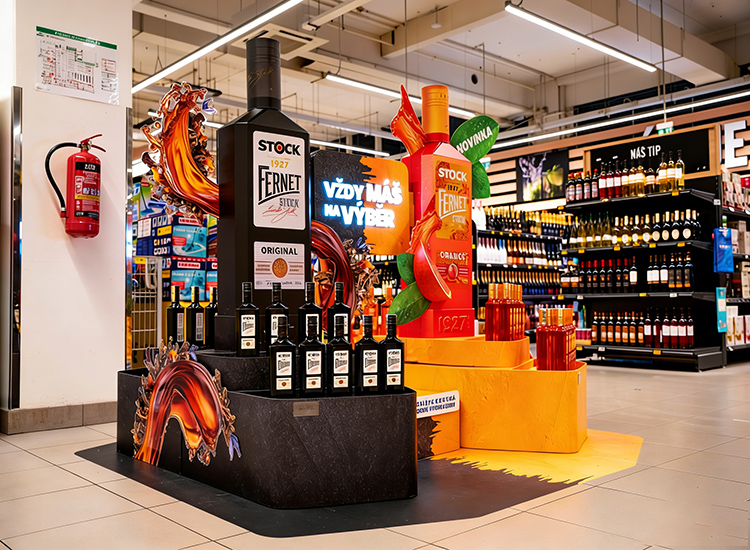
The Fernet Stock installation works on that level. It is much more immersive than a standard promotional sign, but it still keeps the product central. The oversized bottle structures, liquid-inspired graphics, and strong black-orange contrast make the display feel dramatic, but not chaotic. It does not just advertise the product. It builds a branded zone around it. That difference matters. Done well, this kind of POP can shape the atmosphere of the aisle itself.
This is also a useful reminder that POP does not always need to stay small to stay effective. It just needs control. Scale helps when the idea remains clear.
At a practical level, effective POP Display usually comes down to three things:
a message that can be understood quickly
a design that fits the product and the shopper
enough originality to avoid disappearing into repetition
That sounds simple. It is not. Those three things are exactly where many displays fail.
The stores and brands that do POP well are usually not the ones using the most signage. They are the ones that think more carefully about what the shopper needs to notice first, what feeling the display should create, and what kind of message the retail environment can actually carry.
A useful POP display is not just visible. It is intentional.
Conclusion
Store POP Display remains one of the most practical and influential tools in retail because it works where decisions happen. It shapes attention, supports product comparison, reinforces brand tone, and changes how the store speaks to shoppers.
But POP does not become effective just because it is present.
When message and form do not work together, the display loses clarity.
When customer differences are ignored, the display loses relevance.
When innovation disappears, the display loses stopping power.
That is why better POP is not about adding more promotional material. It is about thinking more carefully about what the display is really meant to do.
The best store POP does not just sit there. It actively helps the product get chosen.


3/F No. 6 Hedi Road, Gongming Street, Guangming District, Shenzhen City, GD, China, 518106


