
In many retail programs, a display can look impressive on the shop floor—but perform poorly in shipping.
That disconnect often comes from one overlooked detail: pallet loading efficiency.
For brands rolling out pop displays or large-scale point of purchase displays, pallet layout is not just a logistics concern. It directly impacts freight cost, packaging design, rollout speed, and even store-level execution. And unlike standard cartons, display structures introduce irregular shapes, stacking constraints, and material sensitivities.
This is where a multi-factor approach becomes essential.
A Pallet Display is not just a transport unit—it is part of the retail execution strategy.Whether it’s a pallet shop display in a supermarket aisle or a branded floor unit shipped in bulk, how efficiently displays are loaded onto pallets determines:
how many units fit per shipment
how much packaging material is required
how stable the load remains during transit
how quickly stores can receive and deploy displays
Unlike uniform packaging boxes, pallet displays for retail often involve mixed structures—angled shelves, headers, hooks, or layered components. That makes layout planning significantly more complex.
In practice, improving pallet efficiency is not about “fitting more units.”
It’s about balancing structure, packaging, and logistics constraints.
One of the key challenges in display shipping is dealing with irregular geometry.
A typical retail display may include:
a base platform
vertical supports
branding panels
product-holding components
These do not behave like simple rectangular cartons.
A more effective approach is to simplify the structure into a layout model:
Convert complex 3D shapes into manageable 2D placement logic
Define orientation constraints (no flipping, fixed base direction)
Identify stackable zones within the display structure
Treat the pallet as a bounded layout space
This allows engineers and sourcing teams to move from guesswork to structured layout planning.
For small shipments, manual arrangement might work.
But for large retail programs—especially those involving Quarter Pallet Display or Half Pallet Display formats—manual planning quickly becomes inefficient.
The challenge is not just positioning displays, but optimizing across multiple variables:
pallet dimensions
display footprint
packaging thickness
stacking rules
weight limits
These variables interact. Changing one often affects the others.
This is why data-driven approaches—such as algorithm-assisted layout planning—are increasingly used. Not because they are “advanced,” but because they are practical. They help identify efficient configurations in minutes rather than relying on repeated trial and error.
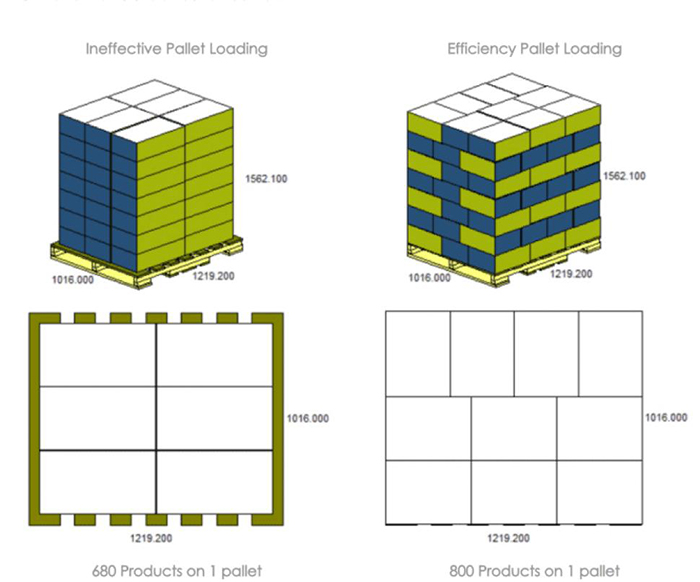
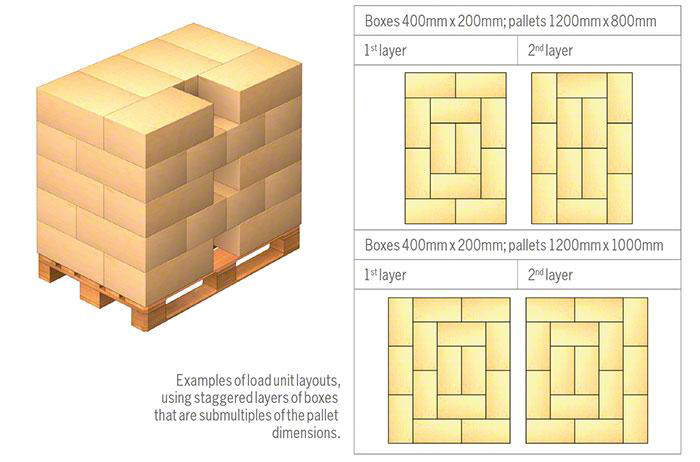
While many variables are involved, three factors consistently drive layout outcomes.
It seems obvious that a larger pallet can carry more displays.
But in reality, pallet loading does not increase in a smooth, predictable way.
Small changes in pallet dimensions can:
unlock a new layout pattern
or create unused space that reduces efficiency
In some cases, two different pallet sizes may hold the same number of displays—but with very different stability, packaging complexity, or loading difficulty.
This is especially relevant for standardized retail formats such as:
Quarter Pallet Display
Half Pallet Display
full pallet displays for retail
Choosing the right pallet size is not just about capacity. It’s about how well the display footprint aligns with that size.
Packaging is often treated as a secondary consideration.
But even small increases in material thickness can significantly affect pallet layout.
Why?
Because packaging effectively increases the footprint of each display unit.
And when multiplied across a full pallet, this can reduce the total number of units that fit.
What makes this more complex is that the impact is not linear.
In many cases:
layout efficiency drops in steps, not gradually
small thickness increases can trigger a sudden loss of one or more units per pallet
This creates what engineers often refer to as “breakpoints.”
From a practical standpoint:
slightly thinner packaging may improve loading efficiency
but must still meet protection requirements
The goal is not minimum thickness—it’s optimal balance.
One of the most overlooked factors is the display itself.
The base dimensions of a display—especially for point of purchase displays—have a direct effect on pallet efficiency.
Key observations include:
Smaller or better-proportioned bases often increase loading quantity
Dimensions aligned with logistics modules (e.g., standard pallet grids) perform better
Even minor size adjustments can unlock more efficient layouts
This means pallet optimization should not be treated as a post-design task.
It should be considered during:
structural design
material selection
display footprint planning
For brands investing in large-scale pop displays, this can significantly reduce long-term logistics cost.
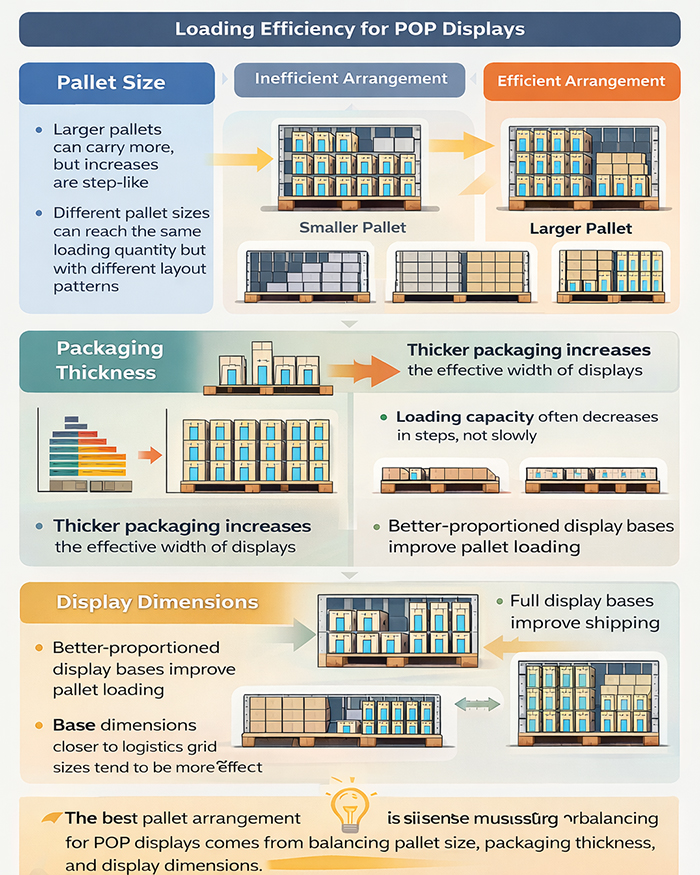
In theory, the optimal layout is the one that maximizes the number of displays per pallet.
In practice, it’s more complicated.
Two layouts may offer the same loading quantity—but differ in:
ease of packing
packaging cost
structural stability
handling efficiency
Sometimes, a slightly less dense layout is preferred because:
it reduces packaging complexity
it improves loading speed
it lowers risk during transport
This is especially true for pallet shop display programs that need to be deployed quickly across multiple retail locations.
The best solution is not always the most compact—it’s the most operationally efficient.
For brands, retailers, and sourcing teams, the implications are clear.
1. Consider pallet layout early
Do not wait until the shipping stage.
Layout efficiency should be part of the initial display concept.
2. Evaluate packaging as part of layout design
Packaging thickness and structure should be aligned with loading strategy—not decided independently.
3.Design displays with logistics in mind
A display that fits retail space but ignores pallet efficiency may create long-term cost issues.
4. Align design, packaging, and logistics teams
Pallet loading is not a single-department decision. It sits at the intersection of:
design
engineering
packaging
supply chain
FAQ
1.What is a pallet display in retail?
A pallet display is a retail-ready unit designed to hold products while also serving as a transport base. It is commonly used in supermarkets and high-traffic retail environments.
2.Why are pallet displays harder to optimize than standard packaging?
Because they often have irregular shapes, structural constraints, and stacking limitations that do not apply to standard cartons.
3.How does packaging affect pallet loading?
Packaging increases the effective size of each unit. Even small thickness changes can reduce how many displays fit on a pallet
4.What is the difference between Quarter and Half Pallet Displays?
A Quarter Pallet Display occupies one-quarter of a standard pallet footprint, while a Half Pallet Display occupies half. Both are used to match retail space and logistics efficiency.
5.Can pallet optimization reduce logistics cost?
Yes. Better pallet utilization reduces the number of shipments, lowers packaging waste, and improves transport efficiency.
Conclusion
Pallet layout for pop displays is not just a packaging detail—it is a multi-factor optimization problem.
Pallet size, packaging thickness, and display dimensions all interact in ways that directly affect shipping efficiency and cost. And while maximizing load quantity is important, it is not the only goal.
The most effective solutions come from understanding how these variables work together—and making decisions early, not at the end of the process.
For any brand planning a retail rollout, especially involving point of purchase displays, pallet optimization should be part of the conversation from day one.


3/F No. 6 Hedi Road, Gongming Street, Guangming District, Shenzhen City, GD, China, 518106


