
Walk into any supermarket, convenience store, or shopping mall, and the same thing often happens: a shopper enters with a simple list, but ends up leaving with items that were never part of the original plan. In many cases, that extra purchase is not driven by a TV commercial or an online ad. It happens because something inside the store catches the eye at exactly the right moment.
That is where POP advertising comes in. POP, or point of purchase advertising, refers to the promotional materials placed where buying decisions are made. It may appear as a poster, a hanging sign, a price card, a shelf talker, or a more structured pop display that turns a product into the visual focus of a retail space. Its value is not simply in decoration. Its real power lies in helping products get noticed, understood, compared, and bought.
POP advertising is one of the most direct forms of retail communication because it appears at the exact place where consumers are closest to making a purchase decision. Unlike television commercials, social media ads, or billboards, POP advertising operates inside the store, in the immediate environment where products compete for attention.
In practical terms, POP is far more than a simple poster. It includes display stands, promotional signs, endcap graphics, hanging banners, shelf labels, checkout displays, and all kinds of visual devices designed to support product sales in-store. That is why reducing POP to “just a poster” is too narrow. A poster may be one form of POP advertising, but a strong pop display can go much further by creating physical presence and stronger retail impact.
This is also why point of purchase advertising remains so important today. It works at the final stage of the customer journey, where interest can turn into action.
The importance of POP advertising is not abstract. It affects real buying behavior in visible ways.
1. It Captures Attention First
Retail stores are visually crowded environments. Similar products often sit close together, competing for the same limited customer attention. Before a shopper can compare, evaluate, or purchase a product, that product must first be noticed.
This is the first role of POP advertising: it interrupts routine browsing. Whether it is a bold promotional sign or a carefully designed pop display, it helps a product stand out from the background of ordinary shelf presentation.
2. It Shortens the Time Needed to Understand a Product
Shoppers do not spend long reading in-store. In many cases, they decide within seconds whether something is relevant. A good POP message helps answer the most important questions quickly:
What is this product?
What makes it different?
Why should I consider it now?
Is there a promotion or special benefit?
This is what makes point of purchase advertising so effective. It does not just attract attention. It also reduces decision friction.
3. It Turns Interest Into Action
Getting noticed is only the beginning. The real strength of POP advertising lies in its ability to move a shopper from curiosity to purchase. It can create urgency, reinforce value, highlight promotions, and make a product feel more immediately relevant.
That is why POP advertising plays such an important role in retail promotion. It helps transform a passive viewing moment into an active buying decision.
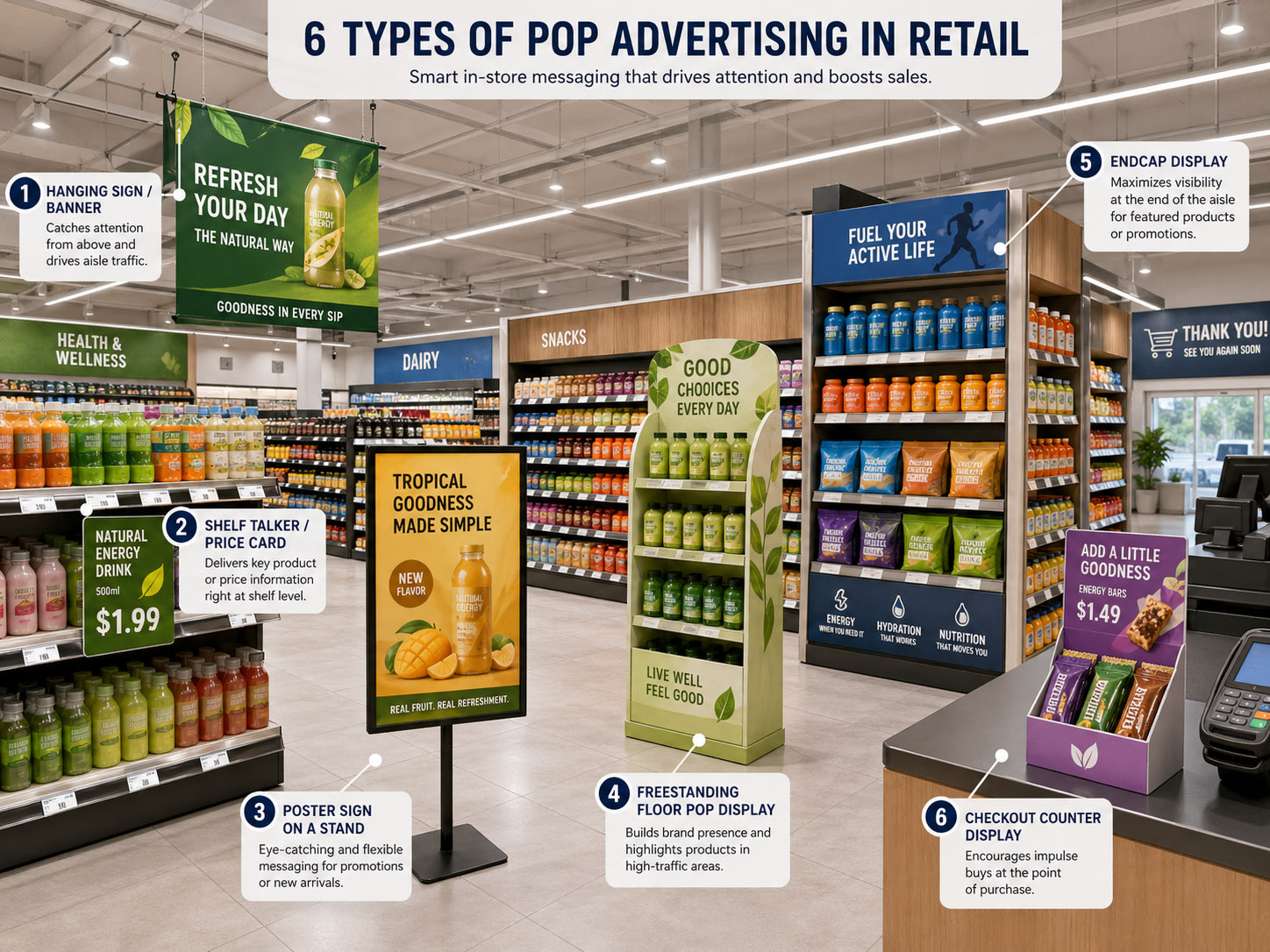
POP advertising appears in many forms, and each form supports promotion in a slightly different way.
This includes posters, price cards, hanging signs, stickers, and shelf graphics. These formats are highly effective for delivering quick messages such as discounts, special offers, seasonal themes, or new product announcements.
Their main strength is speed. They tell the shopper, very quickly, “something important is happening here.”
A structured pop display has a different role. It does not just transmit information. It reshapes the way the product appears in the store. Floor stands, endcaps, themed islands, and custom display units give products stronger visual presence and often create a more memorable retail experience.
Compared with flat materials, they are more likely to function as focal points in the selling space.
More advanced POP advertising often creates a full visual setting rather than showing only the product itself. Seasonal promotions, themed gift displays, festival displays, and lifestyle-based product presentations all fall into this category.
This approach is especially useful for categories linked to mood, experience, and impulse, such as beverages, snacks, beauty products, and giftable packaged goods.
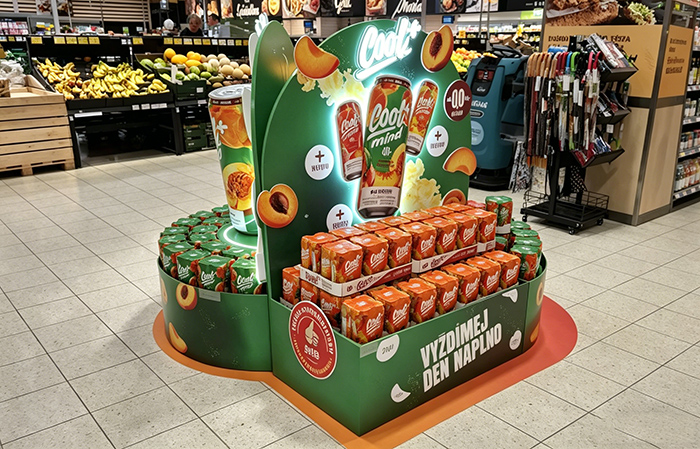
This beverage display is a strong example of how a themed pop display can enhance product promotion. Instead of simply placing cartons on a shelf, the display uses oversized product visuals, fruit graphics, dramatic color blocking, and illuminated brand elements to create a dedicated promotional zone inside the store.
What makes this case effective is that it does more than present stock. It builds atmosphere. The display immediately signals flavor, freshness, and energy. It also gives the product a stronger visual identity in the retail environment, making it easier for shoppers to notice, approach, and consider.
For beverage categories, where the buying decision is often quick and emotionally influenced, this kind of point of purchase advertising can be much more powerful than standard shelf placement alone.
If we look at the real customer journey inside a store, POP advertising influences more than one stage of the decision process.
It Helps Consumers Discover the Product
Some products fail not because they are poor, but because they remain invisible. POP advertising solves this first problem by increasing product visibility and drawing attention where normal shelf presentation may be too weak.
It Helps Consumers Understand Product Value
A product may be seen, but still not chosen. This is where POP advertising adds another layer of value. It can highlight key features, explain benefits, show usage situations, and support quick comparison with competing items.
This function is especially important for new products, feature-driven products, or products in crowded categories.
It Helps Consumers Complete the Purchase
At the final stage, POP advertising pushes the shopper closer to action. Through pricing messages, limited-time offers, bundle communication, or stronger in-store presence, it helps convert interest into purchase.
That is why POP advertising is not simply a visibility tool. It is a conversion tool.
Not every POP campaign works equally well. To truly support sales, POP advertising needs to do more than look attractive.
1. The Message Must Be Clear
Retail messages need to be read quickly. If the content is overloaded or visually confusing, the display loses power. Shoppers should be able to understand the product, the offer, or the reason to stop within seconds.
2. The Design Should Match the Brand and the Store
A good POP design does not mean “the louder, the better.” It should fit the product category, the target customer, the store atmosphere, and the brand identity. A mass-market snack promotion and a premium beauty campaign should not look the same.
3. Placement Matters as Much as Design
Even a strong POP concept can underperform if it is placed badly. Entry zones, aisle ends, checkout areas, main traffic routes, and feature display areas all influence how well the advertising performs. In retail, location is not a secondary issue. It is part of the promotional strategy itself.
Conclusion: Why POP Advertising Still Matters in Retail Promotion
POP advertising is not just a decorative extra in the store. It is one of the closest communication tools between a product and a consumer at the exact moment a buying decision is about to happen.
A good pop display does more than make a product look attractive. It helps the product get seen, understood, compared, and chosen. That is why point of purchase advertising continues to play such an important role in modern retail.
No matter how much media changes, shoppers still make many final decisions in-store. And at that decisive moment, POP advertising remains one of the most effective ways to influence product promotion and improve retail conversion.
FAQ
1.What is point of purchase advertising?
Point of purchase advertising refers to promotional materials placed near the actual buying location, such as shelves, checkout areas, display stands, or promotional islands, to influence shoppers at the moment of decision.
2.How does a pop display influence customer buying behavior?
A pop display helps attract attention, communicate product value quickly, and encourage consumers to move from noticing a product to considering and buying it.
3.Why is POP advertising important in retail stores?
Because retail shoppers make many decisions in-store, POP advertising helps products stand out, explains key selling points, and increases the chance of conversion at the point of purchase.
4.What types of POP advertising are most effective in supermarkets?
In supermarkets, effective POP advertising often includes endcap displays, floor stands, promotional islands, hanging signs, shelf talkers, and themed pop display units with clear product or price messages.
5.How can a pop display improve product promotion?
A good pop display improves product promotion by increasing visibility, shortening the decision process, creating promotional atmosphere, and making the product easier to notice and buy.


3/F No. 6 Hedi Road, Gongming Street, Guangming District, Shenzhen City, GD, China, 518106


