
Acrylic display stands look simple at first glance. A clear panel here, a shelf there, maybe a logo on the front. That is the part buyers see. What they do not always see is how much the final result depends on fabrication. The same acrylic display can look sharp, clean, and premium in one project, then cheap and slightly rough in another. Usually, the difference is not the acrylic sheet alone. It is the process behind it.
That is why this topic matters. If you are buying an acrylic display stand, comparing suppliers, or planning a custom acrylic display stand for retail, it helps to know what actually goes into production. Cutting, bending, bonding, polishing, and forming are not just factory terms. They shape the way the stand looks, feels, performs, and sells.
An acrylic display stand is a display fixture made mainly from acrylic sheet or formed acrylic parts. In retail, it is commonly used to hold, separate, elevate, or highlight products in a clean and visually light way. Some designs are simple countertop holders. Others are tiered structures, risers, brochure holders, or multi-level acrylic display shelf units used for organized product presentation.
Compared with many other plastic display stands, acrylic usually gives a clearer and more refined visual effect. Products stay easy to see, the structure feels less heavy, and the overall presentation can look more premium. That is one reason acrylic display solutions are so common in cosmetics, electronics, accessories, gifting, and small-item retail.
Acrylic display stands are widely used in beauty and skincare retail. That makes sense. Transparent structures work well for serums, lipsticks, testers, and boxed beauty products because the display does not visually block the product.
They are also common in electronics and accessories. Earphones, chargers, cables, watches, phone accessories, and other compact items are often easier to organize in an acrylic display shelf or tiered acrylic stand than in a deeper, more visually crowded fixture.
Beyond that, acrylic is often used for countertop promotions, literature holders, and pop display support pieces. In some cases, the acrylic part is the full display. In others, it is only one component in a broader retail display program.
This is the core of the topic. A high-quality acrylic display stand is rarely the result of just one process. It is usually the result of several processes working together in the right sequence. Public acrylic fabrication references commonly center the process around cutting, line bending or heat bending, thermoforming, bonding or cementing, and edge finishing or polishing.
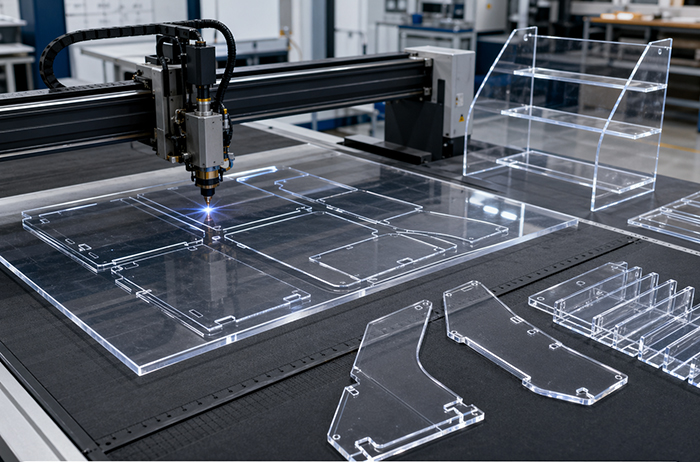
Cutting is where most acrylic display projects begin. Acrylic sheets have to be turned into usable parts: side panels, shelves, dividers, holders, risers, logo shapes, or product supports. That may sound basic, but cutting quality has a bigger effect than many buyers expect.
Accurate cutting helps parts fit better during assembly, improves edge consistency, and reduces issues later in bonding and finishing. Laser cutting is often associated with clean, detailed cuts, while CNC cutting is frequently used where routed shapes or different fabrication requirements are involved. Either way, poor cutting creates problems that tend to show up later—misalignment, rough edges, uneven fit, or extra finishing work.
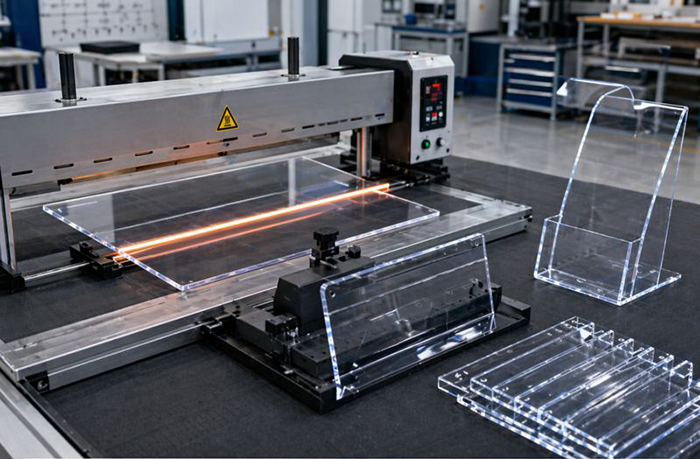
Many acrylic display pieces are not assembled from many small parts. Instead, they are bent into shape from one panel. That is where heat bending, often called line bending, comes in.
This process is commonly used for brochure holders, sign holders, slanted acrylic display shelf forms, and simple countertop structures. It helps reduce the number of bonded joints and can create a cleaner, more minimal look. But it has to be done well. If bending is inconsistent, the angle can feel off, the surface can show stress marks, or the edge may whiten slightly. Those details may seem small, but in retail they affect how polished the display feels. Acme Plastics lists line bending as one of the standard acrylic fabrication methods.
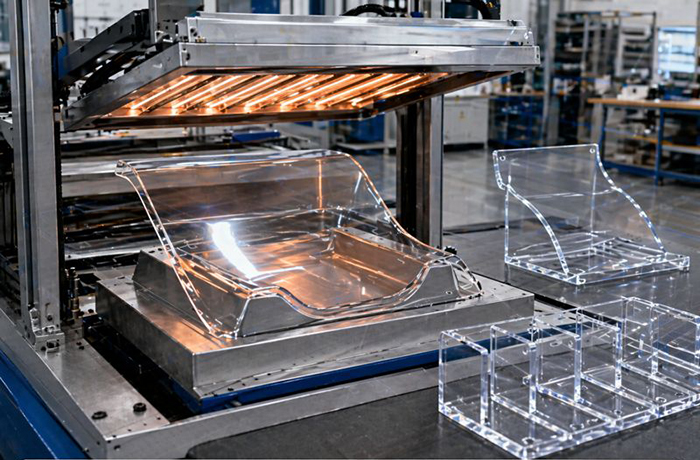
When a design needs more than a simple bend, thermoforming may be used. This is the route for more complex curves, shaped holders, molded fronts, or product cradles that need a more sculpted form.
Not every acrylic display stand needs thermoforming. In fact, many do not. But in a custom acrylic display stand project where the visual shape matters a lot, thermoforming can make a real difference. It gives the designer more freedom and often creates a more distinctive retail look than flat-cut or straight-bent parts alone. Acrylic fabrication references commonly include thermoforming as one of the core ways acrylic can be shaped.
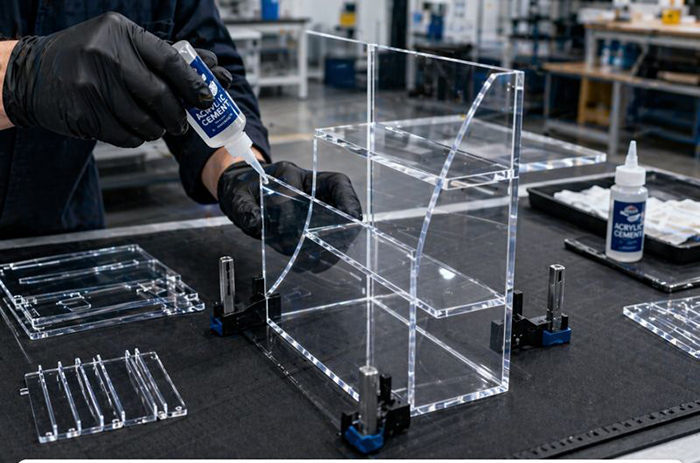
This is one of the most important processes in the whole article, maybe the most important if you care about final appearance.
Bonding or cementing is how separate acrylic parts are joined into a finished display structure. Shelves, risers, side panels, dividers, and holders often depend on clean bonding work. A well-bonded acrylic display can look tidy, stable, and refined. A poorly bonded one can show bubbles, whitening, visible glue marks, messy seams, or weak structural points.
That is why buyers should not treat bonding as a minor step. In many acrylic display projects, the overall impression of quality comes down to how neat the joints look. TAP Plastics specifically highlights gluing and cementing as core acrylic fabrication methods, which makes sense—because assembly quality is not optional. It is part of the product.
If bonding is one of the biggest structure-quality indicators, polishing is one of the biggest visual-quality indicators.
Edge finishing and polishing help determine whether the acrylic looks clear and premium or rough and unfinished. A polished edge usually looks smoother, cleaner, and more refined. This matters even more in transparent displays, because the edge is highly visible. The better the edge finish, the more “finished” the entire product tends to feel.
This is one reason two acrylic display stands can have similar shapes but very different visual impact. One may have sharp, cloudy, or less refined edges. The other may look brighter, clearer, and more expensive, even before the customer reads the branding. Acrylic industry materials repeatedly emphasize polished or finished edges as a meaningful part of product presentation.
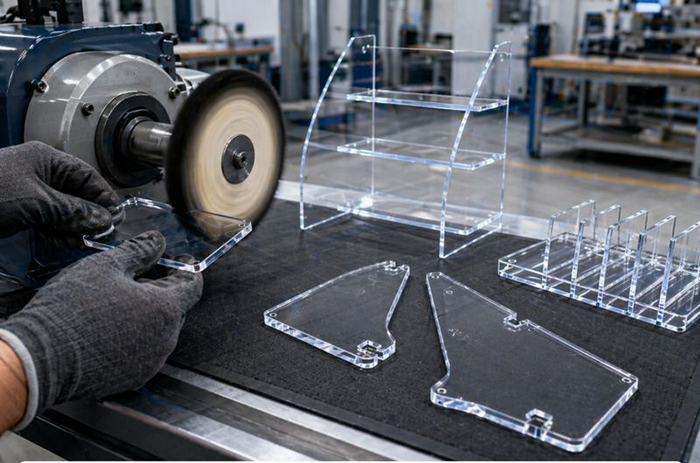
It helps to think about processes in terms of results, not just steps.
Cutting affects fit and precision. Bending affects structure and simplicity. Thermoforming affects shape freedom. Bonding affects seam quality and stability. Polishing affects visual finish and perceived quality. Once you look at the article this way, the topic stops being a factory checklist and starts feeling more relevant to a buyer.
That is also why similar acrylic display products can look fine in photos but feel very different in person. One may have sharper fit, cleaner joints, and smoother edges. Another may technically hold the same product, but still feel less premium overall.
This is where the process discussion becomes practical.
A simple acrylic display shelf with basic cuts and standard assembly will usually cost less than a more refined project that needs complex shaping, cleaner bonding, polished edges, and stronger branding presentation. More parts, more bends, more precision, more finishing—these all increase labor and process time.
The same goes for custom work. A custom acrylic display stand is rarely priced higher just because it is “custom.” It is usually priced higher because the structure needs more process control. That could mean more difficult cutting, more careful bonding, more finishing work, or more demanding visual standards.
So when buyers ask why two acrylic display solutions look similar but come back at different prices, the answer is often simple: the process quality is different.
Before placing an order, buyers should ask more than just size, thickness, and quantity. Those are important, yes, but they are not enough.
A better checklist would include questions like these:
How will the acrylic parts be cut?
Will the edges be polished?
Is the structure bent or bonded?
How clean should the bonded joints look?
Does the project need simple fabrication or a more custom acrylic display stand solution?
Is the display meant for standard shelf use, countertop use, or a pop display program?
Those questions lead to better quotes, better samples, and fewer disappointments later.
Conclusion
Acrylic display stands may look clean and simple, but the final result depends on much more than the sheet material itself. Cutting, bending, thermoforming, bonding, and polishing all shape the way the display looks and performs.
That is the key point. A strong acrylic display is not only about transparency. It is about process quality.
So if you are planning an acrylic display, comparing plastic display stands, or developing a custom acrylic display stand for retail, do not stop at the basic spec sheet. Ask how it is made. Very often, that is where the real difference begins.
FAQ
1.What is the most common process used for an acrylic display stand?
There is no single process that works alone in every project, but cutting, bending, bonding, and polishing are among the most common core processes in acrylic display fabrication.
2.What is the difference between heat bending and thermoforming?
Heat bending is usually used for simpler bends and one-piece angular forms, while thermoforming is more suitable for curved or more complex shaped parts.
3.Why do some acrylic display stands look clearer and smoother than others?
In many cases, the difference comes from edge finishing, polishing quality, and cleaner bonding work rather than from the acrylic sheet alone.
4.Can acrylic display stands be used for pop display projects?
Yes. Acrylic can be used in selected pop display programs, especially when clear product presentation and a light visual structure are important.
5.Why do similar acrylic display stands have different prices?
The difference often comes from cutting complexity, forming difficulty, bonding quality, polishing level, and the overall finish standard rather than from size alone.


3/F No. 6 Hedi Road, Gongming Street, Guangming District, Shenzhen City, GD, China, 518106


