
Walk into a retail store and you can feel the difference almost immediately. Some stores feel organized, persuasive, and easy to shop. Others feel noisy, cluttered, and forgettable. Products may be similar. Prices may be similar. But the way information is presented inside the space changes everything.
This is where POP advertising matters.
A POP display is often seen as a simple in-store promotion tool, something used to push a discount or highlight a featured product. That view is too limited. In real retail settings, POP advertising does much more. It helps products stand out, guides shoppers through decisions, supports brand communication, and shapes the atmosphere of the store itself.
That is why point-of-purchase displays still deserve serious attention. They work close to the product, close to the shopper, and close to the moment when a buying decision is made.
POP advertising is not separate from store design. It is part of it.
Inside a retail space, every visual signal plays a role. Shelving, lighting, product arrangement, signage, display units, and promotional graphics all work together to influence how shoppers move, what they notice, and what they remember. A Retail POP display sits inside that system. It is notjust there to decorate a corner or fill open space. It is there to communicate.
This makes POP advertising more important than it may appear at first glance. It does not only tell shoppers what is on sale. It helps explain what is new, what is worth attention, what the brand wants to emphasize, and what kind of experience the store is trying to create.
A strong display can make the store feel more organized and more intentional. A weak display can do the opposite.
The power of POP advertising comes from its position.
Unlike mass advertising, POP works at the point where shoppers are already close to making a choice. They are not being asked to remember a message for later. They are seeing it while comparing products, scanning shelves, and deciding what to buy. That makes a POP Display stand one of the most direct forms of retail communication.
It also works in a quiet but persistent way.
Sales staff can explain products, but they cannot be everywhere. POP advertising fills that gap. It suggests, reminds, highlights, and reinforces without interrupting the shopper. In self-service environments especially, this matters a lot. People often want guidance, but not pressure. A good display gives them exactly that balance.
That is one reason POP advertising is often so effective. It supports decision-making without forcing it.
POP advertising usually performs more than one function at the same time. The strongest displays are not built around a single task. They work on several levels together.
This is the most obvious role, and still one of the most important.
A POP display helps products stand out in a crowded environment. It can highlight featured items, introduce new launches, support seasonal promotions, or draw attention to categories that might otherwise be ignored. In stores filled with competing packaging and repeated shelf patterns, visibility matters more than many brands expect.
Shoppers do not only respond to products. They respond to how those products are presented.
A well-designed POP Display design helps shoppers understand what they are looking at. It can clarify product benefits, reinforce brand identity, and make promotional messages easier to absorb. This is especially useful when a product needs quick explanation or when a brand wants to create stronger recognition at shelf level.
In this sense, POP advertising becomes a communication bridge between store, brand, product, and shopper.
This role is often underestimated.
POP advertising affects how a retail space feels. It can make the environment more energetic, more premium, more seasonal, more welcoming, or more exciting. When display communication is coordinated and visually thoughtful, the entire store benefits. The shopping experience feels more complete.
A poor display does not just fail to sell well. It can also make the store feel less organized and less credible.
That is why Custom POP displays matter beyond short-term promotion. They influence the tone of the space.
A display may look impressive in isolation, but retail is never an empty stage. There are shelves nearby, promotional signs competing for attention, shoppers moving in different directions, and products that need to be accessed quickly. That is why effective POP advertising has to work in real store conditions, not just in a clean concept drawing.
A good POP Display stand needs to hold attention without creating confusion. It should be readable from a distance, but still feel connected to the product when the shopper gets closer. It also has to fit the traffic flow of the store.
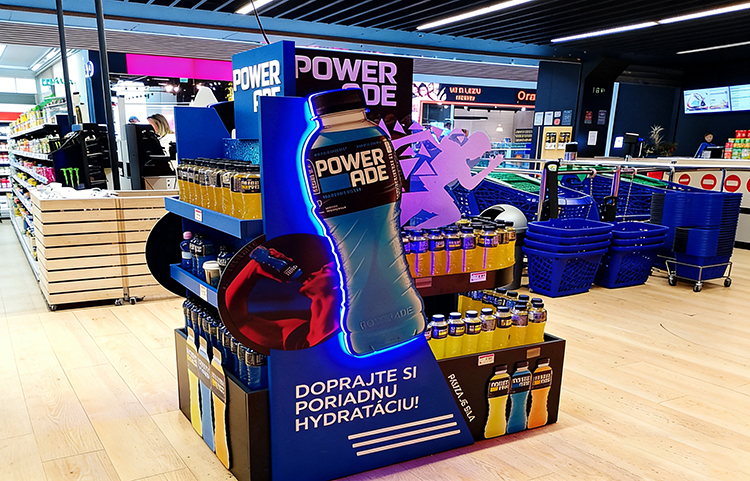
The Powerade display is a good example of this kind of practical clarity. The large bottle silhouette immediately tells shoppers what category they are looking at, while the strong blue color system reinforces brand recognition from a distance. The illuminated outline gives the display more stopping power, but the structure itself stays easy to read.
What makes this case useful is its restraint. The display does not overload the shopper with too many messages. It builds one clear impression first — hydration, energy, sports performance — and lets the stocked bottles support that message. As a POP display example, it shows how a retail unit can be bold without becoming visually chaotic.
Good POP work is rarely just about making something eye-catching. Visual impact matters, of course, but attention alone is not enough. A display also needs structure.
The shopper should understand the message quickly. If there is too much text, too many competing visuals, or no clear focal point, the display loses effectiveness. A strong POP Display stand communicates fast.
Not every element deserves equal attention. The best displays guide the eye in a clear order. First the shopper notices the main visual or product cue. Then the key message. Then the supporting details. That sequence should feel natural.
A display should fit the product, the store, and the shopper. What works for a luxury product may not work for a fast-moving daily item. What works in a premium department store may not work in a discount supermarket. Good POP Display design respects context.
A display needs to attract, but it also needs to sell. If it becomes too decorative, the selling message gets lost. If it becomes too aggressive, the store atmosphere suffers. The strongest point-of-purchase displays balance visual appeal with commercial purpose.
Even though POP advertising is widely used, a lot of in-store display work still falls short. The problems are familiar.
Some displays are created without strong design direction. The result is repetitive layouts, weak visual hierarchy, and low communication value. Some are too focused on surface beauty and forget the actual sales purpose. Others rely too heavily on discount language, repeating the same sale or special offer message until shoppers become numb to it.
There is another issue too: inconsistency.
When displays are designed one by one without a broader retail logic, the store starts to feel fragmented. One message says premium. Another says discount. One area is carefully designed. Another feels improvised. That weakens not just the display, but the store’s identity as a whole.
Many POP display examples look acceptable on their own but perform poorly once placed inside a busy store. They may be hard to read, badly positioned, visually overloaded, or disconnected from the environment around them.
Retailers often reduce POP advertising to price communication. Discounts matter, yes. Promotional urgency matters too. But if every display says the same thing, the impact fades.
A store that relies only on price-led POP messaging ends up flattening its own communication. Everything becomes urgent, so nothing really feels special. The shopper sees signs, but stops responding to them.
Better POP strategy goes further. It can communicate newness, quality, exclusivity, convenience, seasonality, or brand personality. It can support storytelling, not just transactions. That is where Custom POP displays often perform better than generic solutions. They allow the display to reflect a broader retail message instead of repeating the same basic promotion language.
Better POP advertising usually begins with better planning.
POP should not be added at the last minute. It should be developed as part of the overall store communication plan. That makes the display more consistent with the retail environment and more effective in use.
Clearer hierarchy, stronger messaging, better proportion, and more cohesive visual language all come from stronger design decisions. POP may be temporary, but that does not mean it should be careless.
A display has to work in real retail conditions. It needs to be visually strong, but also practical to install, refill, and maintain. Strong POP Display design always considers both appearance and execution.
The most effective displays are not designed in abstraction. They are designed for real people in real stores. That means considering local shopping habits, visual preferences, cultural expectations, and store behavior. Relevance matters more than imitation.
A well-designed display does more than move product. It also changes how shoppers read the brand and the store around it.
This is where POP advertising becomes more than a short-term promotional tool. It begins to shape perception. Some displays create urgency. Some create trust. Some create a sense of quality or indulgence. When the design is strong, the display becomes part of the store’s image rather than just a temporary interruption.
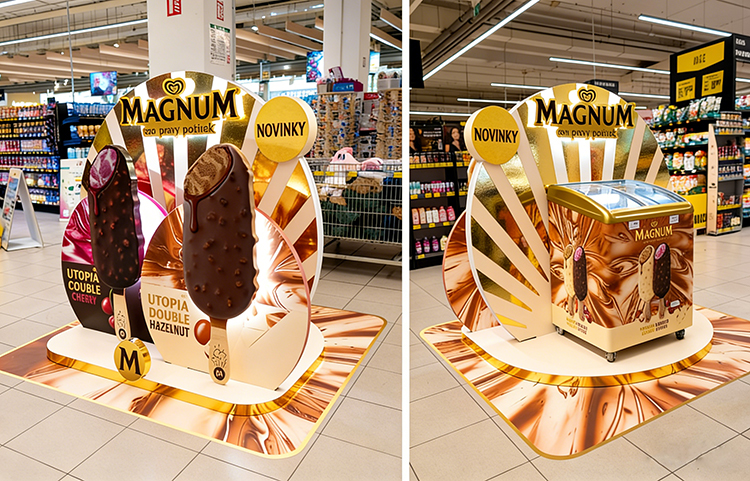
The Magnum installation shows this more clearly. The gold palette, curved framing, oversized product visuals, and integrated freezer work together to create a richer, more premium feeling. It is still promotional, but it does not rely on loud discount language. Instead, it builds desire through atmosphere and presentation.
As one of the stronger POP display examples, it demonstrates how a display can do more than highlight a product. It can also upgrade the mood of the retail space and reinforce a more polished brand image. That is a different kind of selling, but an important one.
Final Thoughts
POP advertising is more than a sales prompt. It is a working part of retail store design.
It shapes visibility, supports communication, strengthens product presentation, and influences how shoppers experience the space around them. That is why a good POP display should never be treated as a minor detail. It plays a real role in how the store performs.
The most effective point-of-purchase displays are clear, relevant, visually disciplined, and fully connected to the retail environment around them. They do not just push products. They help the store speak more clearly.
And in retail, that still matters a great deal.


3/F No. 6 Hedi Road, Gongming Street, Guangming District, Shenzhen City, GD, China, 518106


