
A good POP ad is never just a colorful display placed in a store. What really makes it work is the layout behind it — how the visuals are arranged, how the eye moves, where the message lands, and whether the whole design feels clear in just a few seconds.
That is the part people often miss.
In retail, shoppers do not stop and study a display the way they read a brochure or browse a website. They glance. They react. Sometimes they decide almost instantly. So in point-of-purchase displays, layout is not a decorative layer added at the end. It is the structure that decides whether the design communicates at all.
A strong pop display has to do two things at the same time: attract attention and organize information. If it only looks lively but feels visually messy, shoppers move on. If it is clean but dull, it disappears into the aisle. Good layout sits somewhere in the middle — visible, readable, and deliberate.
In POP advertising, layout is the framework of visual communication. It determines how graphic elements, text, colors, product images, and blank space work together. More importantly, it determines what the shopper notices first.
And that first impression does a lot of heavy lifting.
A shopper usually sees the whole display before reading a single line. So the layout has to create order fast. The main visual needs to stand out. The supporting message needs to be easy to follow. The product itself should feel connected to the design, not awkwardly dropped into it.
This is where effective Pop Display design separates itself from average work. It is not about adding more design elements. It is about arranging the right ones with enough control that the message feels immediate.
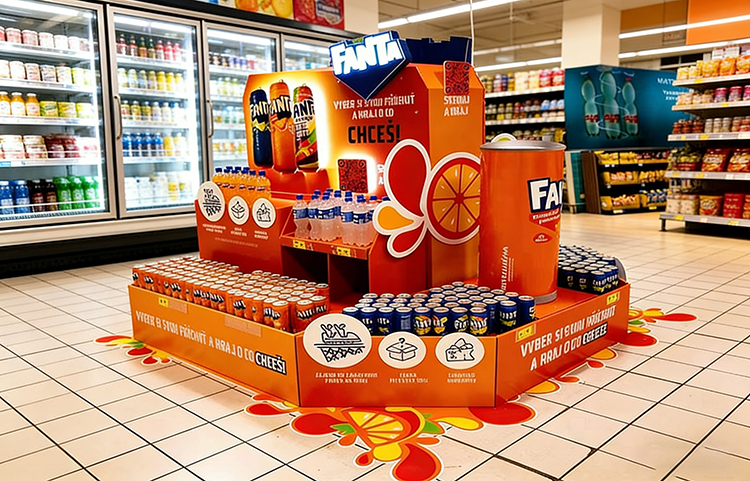
A supermarket Fanta display makes this easy to see. The structure is bold, saturated, and impossible to ignore. Orange dominates the unit, the header rises high above eye level, and the central graphics lock attention almost immediately. It is not subtle. It is not trying to be. In a busy store, that is exactly the point.
What makes it useful as a case is not only the color intensity, but the layout discipline underneath it. The brand sign acts as the visual anchor, the large product graphics build recognition quickly, and the stock zones are arranged in a way that still feels readable despite the amount of product on display. Even the floor decal helps extend the visual footprint. In other words, the display is doing what strong point-of-purchase displays should do: attract attention first, then organize information clearly enough that the shopper is not overwhelmed.
Most POP advertising layouts are built from three primary visual elements: graphics, text, and color. Simple enough on paper. In practice, though, the balance between them is where the real difference shows up.
Graphics are often the first thing shoppers respond to. They are faster than text and usually more emotional. A product image, a bold illustration, even a simple shape can establish the tone before a single word gets processed.
That is why graphics play such a major role in Retail pop display development. They do not just decorate the structure. They signal the category, reinforce the theme, and build visual memory.
Still, graphics have to serve the message. If they are oversized without purpose, or too busy, the display loses focus. The best ones feel sharp and intentional. They do not need to scream from every surface.
Text works differently. It is less immediate than graphics, but more precise. It tells the shopper what the offer is, what the product is about, or why they should care right now.
In a POP Display stand, text should not fight with the visual elements around it. It should guide the eye, support the main message, and add clarity where graphics alone are not enough. Position matters here. Size matters too. So does font choice.
A headline placed at the top usually feels direct and energetic. Text near the bottom feels more grounded. Offset text can create movement, but only if the rest of the layout is stable enough to hold it together.
And honestly, too many fonts ruin things very quickly. One strong headline style, one supporting text style — often that is enough.
Color is probably the fastest trigger in a POP ad. Before shape, before wording, before details. People see color first.
That is why color carries so much weight in Custom POP displays. It can create mood, attract attention, shape brand recognition, and push certain products forward visually. Warm colors tend to feel active and promotional. Cooler tones often feel cleaner, calmer, or more premium.
But color has to be controlled. A strong palette works because it creates hierarchy, not because it uses everything at once. Too many competing tones and the design starts to loosen up in the wrong way. The message gets weaker, not stronger.
This is the part many people underestimate.
Space is not empty. In POP advertising, space controls breathing room, emphasis, and visual rhythm. The distance between text and image, the size of margins, the balance between filled areas and open areas — all of that affects how easy the display is to read.
If elements are packed too tightly, the design feels stressful. If they are scattered too far apart, the display loses unity. Somewhere in between is where the layout starts to feel right.
Proportion matters for the same reason. A display with strong proportion feels balanced even before the viewer knows why. This applies to graphic size, message placement, product imagery, and blank space. Many designers still refer to classic proportional ideas because visual harmony matters in real retail settings, whether people explain it that way or not.
And retail is unforgiving. If the layout feels off, even slightly, the shopper may not consciously notice it — but they still react to it.
Blank space helps the eye rest. It separates major information zones, improves readability, and makes key elements feel more intentional.
Without enough breathing room, even a strong pop display can feel crowded. Too much empty space, though, and the display loses energy. The goal is balance — not emptiness, not overload.
A display that feels balanced often uses proportion well, even if the shopper never notices it directly. The size relationship between the header, product image, copy, and product stock affects how natural the whole structure feels.
That is one reason good Pop Display design always pays attention to proportion, not just surface decoration.
Not every element in a display deserves equal attention. Actually, that is usually where things go wrong.
A strong pop display needs a clear focal point. One main message. One dominant visual direction. It can absolutely include supporting elements, but they should support, not compete.
Large elements naturally attract attention first. Dense groupings do too. That means scale and concentration can be used strategically to establish priority. But once everything is large, bold, and demanding attention, nothing feels important anymore.
That is why the best point-of-purchase displays usually build their message in layers. First the shopper sees the brand or hero image. Then they catch the key message. Then they notice the product and any supporting details. That sequence should feel natural, almost effortless.
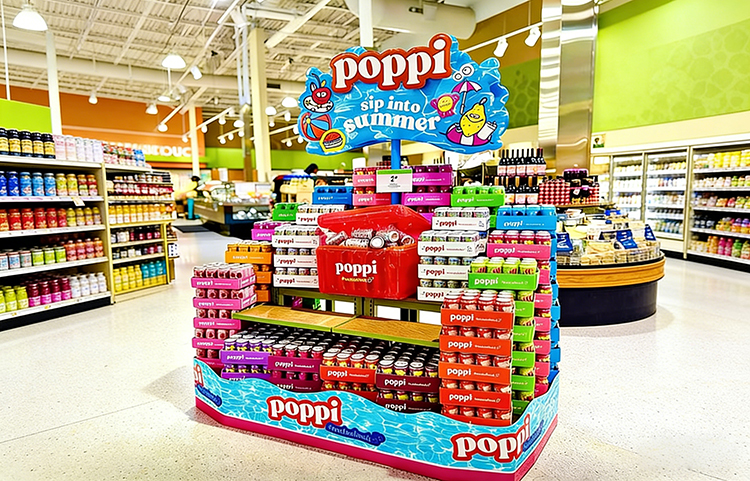
A Poppi display offers a very different rhythm. Compared with the Fanta setup, it feels lighter, more playful, less compressed. The topper establishes the summer theme right away, while the bright product packaging does much of the visual work across the full structure. There is more openness in the presentation, more breathing room, and a softer transition between branding and product.
That difference matters. It shows that effective Pop display examples do not need to follow one visual formula. Some displays rely on strong geometric impact and dense product presentation. Others work through color blocking, seasonal mood, and a more relaxed shopping feel. But the principle stays the same: layout must guide attention, support hierarchy, and keep the display visually coherent. Without that, even a lively Retail pop display can start to feel scattered.
Layout is not built only from the major components. Supporting details shape the final reading experience too.
Typography, border treatments, decorative shapes, icons, and framing devices all affect the tone of a display. These details can help unify the design, strengthen the theme, and improve visual recognition. Or, if overused, they can do the opposite.
That is why supporting design should stay in a supporting role.
If the image needs emphasis, the typography should become quieter. If the headline is the main driver, decorative graphics should step back a little. A good POP Display stand is not the result of every element trying to stand out. It works because each element knows its role.
Sounds simple. It usually is not.
Icons, borders, cutouts, and extra shapes can strengthen a display, but only when they reinforce the main message. If they compete with the headline, the brand block, or the product itself, the layout starts losing clarity.
That is where many otherwise attractive Custom POP displays become less effective than they could be.
At its core, POP advertising layout is about visual efficiency. Not minimalism for the sake of minimalism. Not decoration for decoration’s sake either. Just clarity, emphasis, rhythm, and control.
A successful display should guide attention, communicate quickly, and create a visual experience that feels both attractive and easy to understand. That means the layout has to do more than look good. It has to function well in a real shopping environment.
That is really the key point here.
The value of POP advertising layout is not only aesthetic. It is practical. It shapes how information is received, how products are noticed, and how shoppers respond in the moment. Graphics, text, color, spacing, and supportive details all play a role, but only when they are organized around a clear visual purpose.
That is what turns a display into an effective selling tool rather than just a nice-looking structure.
For brands developing Custom POP displays, that distinction matters a lot. A display that is visually appealing but poorly organized may win internal approval and still underperform on the retail floor. A display with strong hierarchy, clean composition, and smart product visibility usually has a better chance of doing the real job — helping shoppers notice, understand, and act.
The real strength of POP advertising lies in its ability to communicate fast. Layout is what makes that possible.
When the composition is clear, shoppers notice the message without effort. When the hierarchy is strong, the key information lands quickly. When graphics, text, and color are balanced well, the whole display feels natural, even persuasive in a quiet way.
That is why Pop Display design deserves more attention than it usually gets. It is not just surface treatment. It is the visual logic behind performance.
And in physical retail, that logic still matters. A lot.


3/F No. 6 Hedi Road, Gongming Street, Guangming District, Shenzhen City, GD, China, 518106


