
Walk through a supermarket and notice where people slow down.
It is rarely in the middle of a long shelf. Most shoppers move quickly through the aisles, scanning products, checking prices, and picking up familiar brands without much hesitation. But when they reach the end of an aisle, something changes. They turn. They pause for a second. Their eyes reset.
That small pause is exactly why Endcap Displays matter.
In supermarket merchandising, an endcap is not just an extra place to stack products. It is one of the most valuable selling spaces in the store. It gives a product more visibility than a standard shelf, creates a stronger promotional moment, and helps brands reach shoppers before they move into the next aisle.
For retailers, endcaps help guide shopping flow and highlight key categories. For brands, they offer a chance to stand apart from crowded shelf space. When used well, an endcap display can turn ordinary aisle traffic into a focused selling opportunity.
An endcap display is a retail display placed at the end of a store aisle. In supermarkets, it is often used to feature promotional products, seasonal items, new launches, or high-priority SKUs.
Unlike regular shelves, retail end cap displays are seen from more than one direction. Shoppers may notice them while walking across the front of the aisles, turning into a new section, or moving between categories. That makes the location more visible than many standard shelf positions.
A supermarket might use an endcap for summer beverages, holiday candy, breakfast cereal promotions, household cleaning products, or personal care items. These store end cap displays are usually placed where shoppers naturally slow down or change direction, giving products a better chance to be seen.
The important point is this: an endcap display is not only a shelf at the aisle end. A good one combines product arrangement, branding, structure, and promotional messaging in a way that is easy for shoppers to understand quickly.
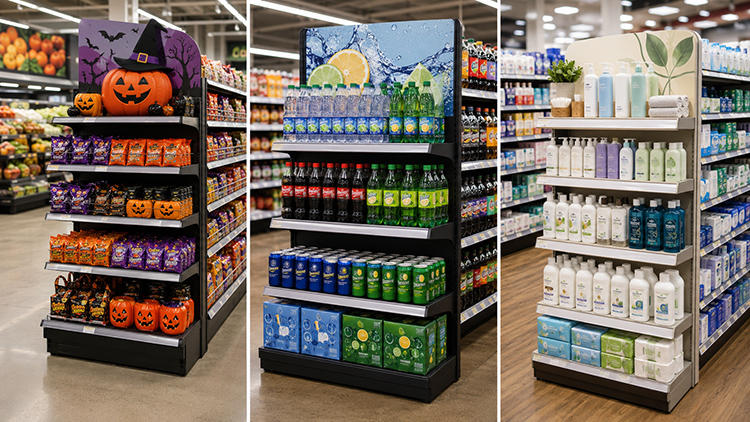
Supermarket shelves are crowded. A product sitting inside its normal category may be surrounded by dozens of similar choices. A snack competes with other snacks. A bottle of juice competes with many other drinks. A personal care product may sit next to nearly identical packaging.
An endcap changes that situation.
It pulls selected products out of the normal shelf environment and gives them their own selling space. Instead of asking shoppers to search, the display presents the product directly.
This is why end cap supermarket displays are often used for promotions and seasonal campaigns. They create a clear focus. A shopper can understand the offer faster, see the product more easily, and make a decision with less effort.
Endcap displays also support impulse buying. A customer may not plan to buy a drink, snack, or holiday item, but when it appears in a high-visibility position with a simple message, the purchase feels easy. It does not need a long explanation. It just needs to be noticed at the right moment.
That is the real role of endcap merchandising. It helps the product enter the shopper’s decision process earlier.
Different endcap displays serve different merchandising goals.
A promotional endcap is usually built around a specific offer. It may feature a discount, bundle deal, limited-time product, or special campaign. These displays need clear messaging because shoppers may only spend a few seconds looking at them.
A seasonal endcap is tied to a shopping period. Think holiday chocolates, summer drinks, back-to-school products, winter skincare, or gift packs. These work well because shoppers already expect certain products at certain times of the year.
A product-focused endcap gives one product or one brand more attention. This is common for new product launches or items that need more visibility than regular shelf space can provide.
A category-focused endcap brings related products together. For example, a supermarket may build a barbecue-themed endcap with sauces, seasonings, paper plates, and drinks. This type of display helps shoppers connect products and build a more complete purchase.
There are also custom end cap displays, which are designed for a specific brand, product size, campaign theme, or supermarket requirement. These are often used when a standard shelf cannot deliver the right visual impact or structure.
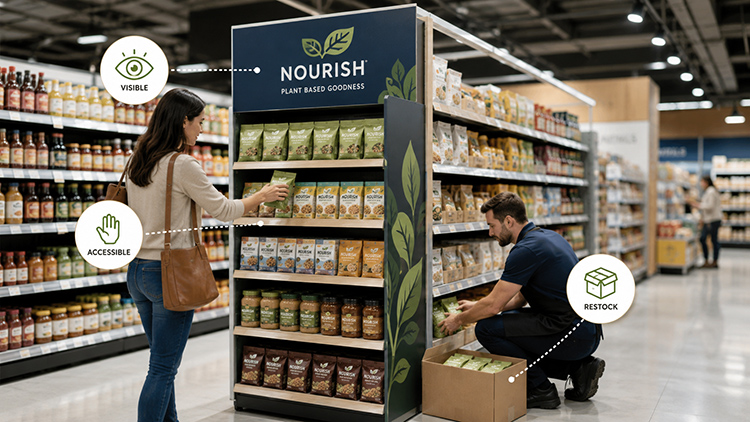
A good endcap display should be easy to notice, easy to understand, and easy to shop.
The first part is visual clarity. Shoppers should quickly understand what the display is promoting. Is it a new product? A price offer? A seasonal theme? A brand campaign? If too many messages compete for attention, the display becomes confusing.
The second part is product access. This sounds basic, but it matters. Products should be easy to see and easy to take. If items are packed too tightly, placed too low, or arranged in a way that makes shoppers hesitate, the display loses some of its value.
The third part is store execution. Supermarkets are busy environments. Products are removed, restocked, moved around, and sometimes placed back incorrectly. A display that only looks good when perfectly full may not perform well throughout the day.
That is why structure and material choice matter. Short-term promotions may use cardboard or PVC displays. Heavier products may require metal support. Premium categories may use wood or acrylic details to create a cleaner branded look. The right choice depends on product weight, campaign length, store conditions, and the type of retail experience the brand wants to create.
Effective retail end cap displays are not just about appearance. They need to support real supermarket use.
Endcap displays are useful because they fit many different promotion types.
For new products, they create early awareness. A new product placed only on a regular shelf may be missed, especially in a crowded category. An endcap gives it a stronger introduction and makes it easier for shoppers to notice.
For seasonal products, endcaps create urgency. Holiday candy, summer beverages, winter skincare, and back-to-school supplies all benefit from short-term visibility. The display tells shoppers, “This is relevant now.”
For fast-moving consumer goods, endcaps can support volume sales. Snacks, drinks, cleaning products, personal care items, and household essentials are often purchased quickly. If the display is clear and easy to shop, it can help move more product.
Endcaps can also support cross-merchandising. A beverage display near snacks, a sauce display near grilling products, or a personal care promotion near pharmacy items can guide shoppers toward related purchases. The display does part of the selling work by making the connection obvious.
The key is relevance. A good endcap should feel useful to the shopper, not random.
Standard supermarket shelving can work for basic product placement. But when a brand has a specific campaign goal, custom end cap displays often provide better control.
A custom display can be designed around the product instead of forcing the product into a fixed shelf layout. Bottles, snack packs, cosmetics, boxed goods, and mixed-size SKUs all need different spacing, structure, and support.
Custom design also improves brand blocking. Instead of blending into shared shelf space, the brand gets a dedicated visual area. Color, graphics, product layout, and materials can work together to create a stronger impression.
For multi-store supermarket promotions, consistency is also important. A display may need to appear across many locations, and it should still look recognizable even when store layouts differ. A well-designed endcap can help maintain that consistency.
There is also the practical side: packing, shipping, assembly, and restocking. These details may not seem exciting, but they often decide whether a display program runs smoothly. A beautiful display that is difficult to ship or refill will not perform well in real retail conditions.
This is why good custom endcap design should consider the full project from the beginning — product, structure, material, branding, logistics, and store-level execution.
One common mistake is trying to communicate too much. A supermarket endcap is not a catalog page. Shoppers are walking, turning, and making quick decisions. The message needs to be simple.
Another mistake is overloading the display. A full display can look abundant, but too much product can make the display feel messy. Full does not always mean effective.
A third mistake is ignoring the store team. If the display is hard to restock, difficult to assemble, or fragile during handling, it will not stay in good condition for long.
The best store end cap displays balance shopper appeal with retail practicality. They need to look good, but they also need to work after a full day of supermarket traffic.
Conclusion
Endcap displays are not just extra shelves at the end of an aisle.
They are high-value merchandising tools that help products stand out, support promotions, and influence shoppers at a moment when attention naturally shifts. Their strength comes from location, but their success depends on much more than location alone.
A strong endcap display needs clear messaging, easy product access, suitable structure, and practical store execution. When these pieces work together, the display does more than hold products.
It turns aisle-end space into a focused selling moment.
Planning a supermarket promotion? Talk to our team about custom end cap displays designed for product visibility, store execution, and retail sales impact.
FAQ
1.What are endcap displays in supermarkets?
Endcap displays are product displays placed at the end of supermarket aisles. They are used to improve visibility, highlight promotions, and attract shopper attention in high-traffic areas.
2.Why are endcap displays important in supermarket merchandising?
They are important because aisle ends are natural pause points. Shoppers often slow down, turn, or scan nearby products in these areas, giving endcap displays stronger visibility than regular shelves.
3.What products work best on endcap displays?
New products, seasonal items, beverages, snacks, personal care products, household goods, promotional bundles, and high-priority SKUs often work well on endcap displays.
4.Are custom end cap displays better than standard shelves?
For simple placement, standard shelves may be enough. For brand campaigns, product launches, or multi-store promotions, custom end cap displays can provide better branding, structure, visibility, and execution.
5.What materials are used for store end cap displays?
Common materials include cardboard, PVC, metal, wood, acrylic, or mixed-material structures. The best option depends on product weight, campaign duration, brand positioning, and supermarket requirements.


3/F No. 6 Hedi Road, Gongming Street, Guangming District, Shenzhen City, GD, China, 518106


