
Retail competition rarely happens in a clean, empty space.
It happens beside another brand. Across from another promotion. Near a shelf where shoppers are already comparing price, packaging, size, and familiarity. Sometimes the difference between being noticed and being ignored is not the product itself, but where and how the product is presented.
That is where a POP display becomes more than a product holder.
In a crowded retail store, a display has to do several jobs at once. It needs to pull shoppers closer, make the offer visible, explain the product quickly, and give people a reason to choose one brand over another. A beautiful display is useful, but beauty alone does not win the sale. The real value comes when the display helps the shopper move from “I saw it” to “I understand it” to “I’ll take it.”
This is especially important when your product sits near rival products. In that situation, the display is not only competing for attention. It is competing for trust, clarity, and decision speed.
Many brands make the mistake of thinking their display area is limited to their own fixture. In reality, shoppers do not see retail space that way.
They see the whole zone.
They notice what is nearby, what is brighter, what looks easier to understand, and what seems more active. If a rival brand has a stronger visual presence near the same traffic path, your product may lose attention before the shopper even reaches your shelf.
That is why retail display planning should not begin with the fixture alone. It should begin with the surrounding space. Where do shoppers come from? What do they see first? Which competitor is placed closest? Is there a main aisle, entrance, checkout path, or category transition nearby?
A strong point of purchase display works with these realities instead of pretending they do not exist.
In competitive stores, visibility is not random. It is created by position, angle, color, message, and timing.
A good display does not wait quietly for shoppers to arrive. It gives them a reason to come closer.
This is where placement becomes critical. A display near an aisle entrance, open traffic zone, escalator area, or category transition can reach shoppers before they begin serious comparison. It can interrupt their routine just enough to make them look.
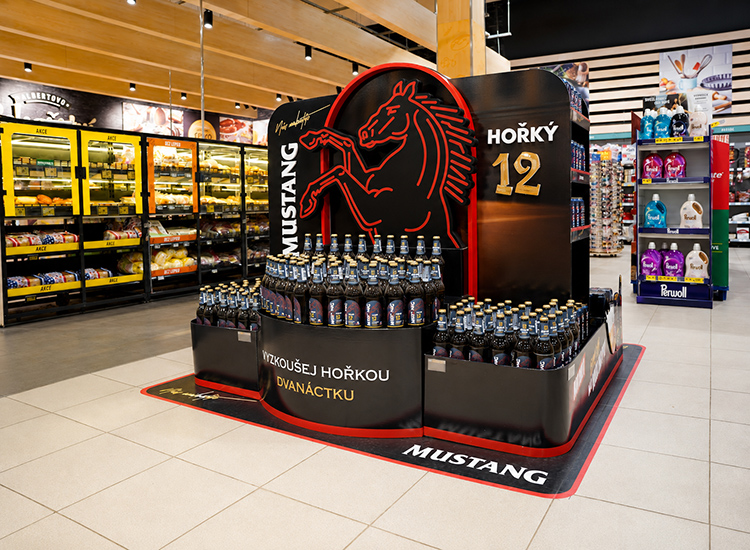
The Mustang beverage display is a good example of this idea. It does not sit quietly inside a regular beverage shelf. It creates a dedicated branded zone in the supermarket, using strong dark colors, bold red contrast, a large graphic element, and a wide product footprint. The display claims attention before shoppers start comparing other drinks nearby. It gives the brand a physical presence that feels bigger than the individual bottles.
That is the point.
In a high-traffic retail environment, a retail POP display should not only show inventory. It should create a small destination. The shopper should feel that this area is worth a closer look.
This does not always require a large structure. Even a smaller display can do the same job if the position, message, and product arrangement are clear. But the principle is the same: the display must pull attention toward the brand before competing messages take over.
Being near competitors is not always a disadvantage. Sometimes it is an opportunity.
When rival products are close, shoppers are already in comparison mode. They are looking for differences, even if they do it quickly. Price, size, flavor, packaging, promotion, and perceived value all begin to matter.
A POP display can make that comparison easier for your product.
But only if it is designed with comparison in mind.
The first visible message matters. If the shopper sees the rival brand first and your offer second, your display has to work harder. If your display faces the wrong direction, hides the strongest selling point, or places the price too low to notice, the comparison may be over before it starts.
This is why display orientation is important. The main graphic panel should face the shopper’s natural path. Price labels should not be treated as small afterthoughts. Product benefits should appear where the eye lands first, not buried near the bottom.
In a crowded store, shoppers do not give every product equal time. The brand that communicates faster often has the advantage.
Price is rarely just a number in retail.
A shopper may not always choose the cheapest product, but they want to understand the value quickly. If they cannot see why a product is worth considering, they may move to a familiar brand or a clearer offer.
This is where many point of purchase displays underperform. They look attractive, but they do not explain enough.
A strong display should make the product’s value visible before the shopper has to ask. That could mean showing a simple promotion, highlighting a bundle, making the product benefit clear, or using packaging arrangement to show variety and choice.
For example, if a product is not the lowest-priced option, the display needs to support the reason behind the price. Better quality, larger size, special formula, seasonal relevance, limited offer, or brand trust — whatever the value is, it should be easy to see.
This does not mean covering the display with text. It means choosing the right message and making it visible at the right distance.
A shopper should not need to work hard to understand why the product deserves attention.
In competitive retail areas, hesitation is common.
The shopper may stop, look, compare, and still hesitate. Maybe the product is unfamiliar. Maybe the price feels slightly higher. Maybe the packaging is not enough to explain the difference. Maybe there are too many options.
A well-designed POP display helps reduce that doubt.
It can organize products by flavor, size, function, or usage. It can make the hero product more obvious. It can place the best-selling SKU in the strongest position. It can make the promotion easier to understand. It can also make the product easier to touch and pick up.
This sounds basic, but it matters.
If shoppers feel confused, they slow down in the wrong way. They do not move toward purchase; they move toward avoidance. They may return to the familiar shelf, choose a competitor, or leave the category entirely.
A good display removes friction. It gives the shopper enough confidence to make a decision without needing a salesperson to explain every detail.
That is especially valuable in self-service retail environments, where the display often has to do the quiet selling work on its own.
Some displays are full, but not persuasive.
They hold many products, yet they do not create a reason to stop. In a competitive store, that is not enough. A display has to create an atmosphere around the product. It has to make the area feel active, intentional, and connected to a brand or promotion.
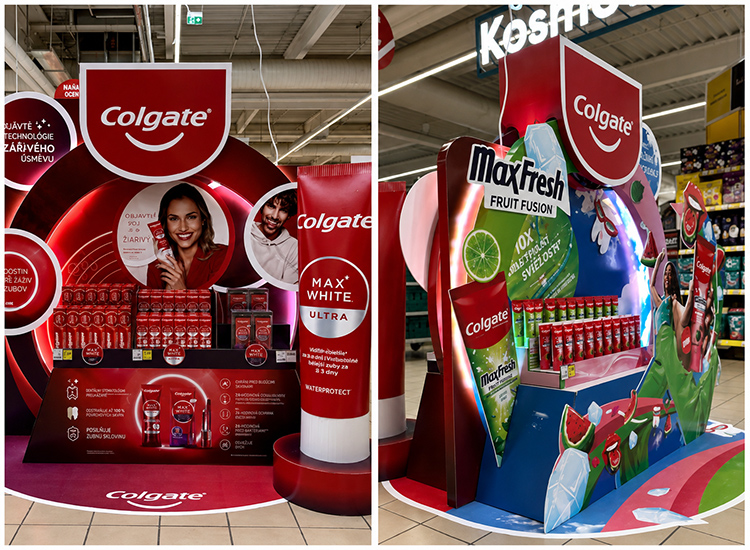
The Colgate display shows this in a different way from the Mustang beverage display. Instead of relying mainly on scale, it uses strong red brand blocking, oversized product visuals, curved structures, and themed graphics to create a clear promotional zone. In a personal care aisle, where many toothpaste products can look similar from a distance, this kind of display helps the shopper recognize the brand quickly and understand the campaign with less effort.
That is what brand blocking does well.
It does not just make a logo larger. It groups the product, message, color, and display shape into one recognizable retail moment. The shopper does not have to search through a crowded shelf of small boxes. The brand has already been pulled forward.
For categories such as oral care, cosmetics, skincare, beverages, snacks, and household products, this can make a real difference. Many products in these categories are similar enough that shoppers need a clear reason to pause. A strong display creates that reason.
Standard shelves are useful. They are efficient, familiar, and easy for stores to manage. But they are not always enough for competitive product placement.
A brand may need custom POP displays when the retail challenge is more specific. For example, the product may need to stand out near a powerful competitor. The campaign may require stronger graphics. The display may need to hold several SKUs without looking messy. The product may be heavy, fragile, premium, or difficult to present on regular shelving.
Custom displays are also useful when the shopper path matters. A display can be designed to face traffic from a certain direction, create a stronger first impression, or connect with a nearby category.
This is where structure, material, and engineering become part of the marketing decision.
A cardboard display may work for a short seasonal promotion. PVC can offer a cleaner medium-term solution. Metal may be needed for load-bearing strength. Wood or acrylic details can help create a more premium presentation. Sometimes the best answer is a mixed-material structure that balances visual impact, durability, transport, and store-level execution.
The goal is not to make the display complicated. The goal is to make it fit the job.
One common mistake is only focusing on the brand’s own display area.
In reality, the surrounding space often decides whether the display works. If the competitor’s display blocks the main sightline, or if shoppers approach from the opposite direction, your display may be technically well-designed but poorly positioned.
Another mistake is making the display attractive but unclear. A shopper may notice it, but if the message is not quick to understand, attention does not turn into action.
A third mistake is ignoring store execution. A display may look strong in a presentation, but if it is difficult to refill, unstable after products are removed, or too complex for store staff to maintain, the impact will fade quickly.
Retail display design has to survive real retail behavior.
People pick things up. Staff restock in a hurry. Shoppers block aisles. Products move. Promotions change. A good display must still make sense after all of that.
A POP display should not be judged only by whether it looks good in a photo.
A better question is whether it changes the shopper’s behavior in the store.
Does it get noticed before the regular shelf?
Does it make the offer clear enough?
Does it help the shopper compare your product against nearby choices?
Can people take the product easily?
Does the display stay organized during the day?
Does it still look like a brand zone after shoppers interact with it?
These questions are more practical than simply asking whether the display is “nice.”
In competitive retail spaces, the display has a job to do. It must help the brand gain attention, communicate value, reduce doubt, and support the final purchase decision.
If it does that, it is working.
FAQ
1.What is a POP display in retail?
A POP display, or point of purchase display, is an in-store display placed near the buying decision point. It is used to improve product visibility, present promotions, and help shoppers notice and choose products more easily.
2.How can POP displays help brands compete near rival products?
POP displays help by creating stronger visibility, showing product value clearly, organizing products better, and giving shoppers a reason to choose one brand over nearby alternatives.
3.Where should POP displays be placed in a store?
Effective locations include main aisles, category entrances, aisle ends, checkout areas, open traffic zones, and areas close to competing products where shoppers are already comparing options.
4.Why is price or value communication important on POP displays?
Because shoppers often compare quickly in-store. A clear price, promotion, bundle offer, or product benefit can reduce hesitation and make the buying decision easier.
5.When should a brand choose custom POP displays?
A brand should consider custom POP displays when standard fixtures cannot support the product size, brand message, campaign goal, load-bearing need, shopper path, or competitive retail environment.
Conclusion
In a competitive retail space, a POP display is never just a place to put products.
It helps control the first visible message. It guides shoppers toward the brand zone. It makes value easier to understand before the shopper turns to a rival product. And, when designed well, it reduces hesitation at the exact moment when a purchase decision is forming.
That is why the best point of purchase displays are built around more than appearance. They consider position, shopper movement, product comparison, promotion clarity, material structure, and store execution.
For brands selling near competitors, this matters. A product may already have good quality, strong packaging, or a fair price. But if the shopper does not see the value quickly enough, the opportunity can pass.
A good POP display helps make sure that opportunity is not lost.
Planning an in-store promotion near competing products? Talk to our team about custom POP displays designed for product visibility, shopper flow, and real retail execution.


3/F No. 6 Hedi Road, Gongming Street, Guangming District, Shenzhen City, GD, China, 518106


