
In a crowded retail aisle, not every product gets a fair chance to be noticed. Main shelves are often packed with competing brands, promotional space is limited, and shoppers may pass by without seeing a new product or seasonal offer. This is where a sidekick display can make a practical difference.
A sidekick display is a compact retail display unit placed on the side of a shelf, endcap, gondola fixture, or high-traffic aisle area. It is often used to present small packaged products, impulse-buy items, seasonal promotions, or add-on products without taking up a full floor display space.
For brands and retailers, a well-designed sidekick display for retail promotions offers a simple but effective way to create extra visibility, support shopper decision-making, and bring selected products closer to the buying path.
A sidekick display is a small point-of-purchase display designed to attach to or stand beside an existing retail fixture. It is commonly installed on the side of a gondola shelf, near an endcap, along an aisle, or close to checkout zones.
In many markets, a sidekick display is also called a power wing display, side wing display, or sidecap display. The names may vary, but the basic purpose is similar: to give products an additional selling position in a high-visibility area.
Unlike a large floor display, a sidekick display stand usually holds a focused range of products rather than a large inventory load. Its value comes from visibility, placement, and convenience. It helps shoppers notice products they may not actively search for on the main shelf.
A typical sidekick display may include:
Peg hooks for hanging packaged products
Small shelves for boxed or bottled items
Tray-style pockets for pouches or sachets
Printed header cards and side panels
Corrugated, PVC, acrylic, metal, or mixed-material structures
The right structure depends on product size, weight, packaging format, store placement, and promotion period.
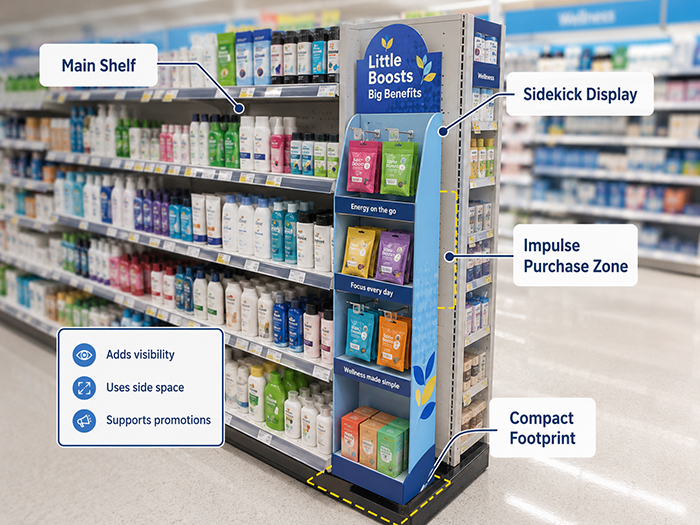
Sidekick displays are popular because they solve a very specific retail problem: how to create more product exposure without taking over expensive shelf or floor space.
Extra Selling Space Without Blocking the Aisle
Retail space is limited. A full floor display can be effective, but it may not always be approved by retailers, especially in narrow aisles or smaller stores. A sidekick display stand uses side space that might otherwise remain unused.
This makes it useful for:Convenience stores, Supermarkets,Pharmacies,Club stores,Discount retail chains,Specialty retail stores
For small and medium-sized products, sidekick displays can add a promotional selling point without disrupting the normal store layout.
Better Visibility Near Shopper Decision Points
A sidekick display works best when placed close to a shopper’s natural path. For example, a snack sidekick display near the beverage aisle can encourage cross-selling. A beauty sample display near a skincare shelf can introduce a trial-size product. A battery display near electronics or checkout can trigger a quick add-on purchase.
This is why retail sidekick displays are often used for impulse-buy products. They bring the product closer to the moment when the shopper is already making related buying decisions.
Suitable for New Product Launches and Seasonal Campaigns
A sidekick display is also useful for limited-time retail promotions. Instead of changing an entire shelf layout, brands can use a compact promotional display to introduce:New flavors,Seasonal packaging,Travel-size products,Holiday gift packs,Promotional bundles,Trial-size SKUs,Clearance or limited-stock items
For new product testing, sidekick displays can be especially practical. They allow the brand to place a product in a visible location and observe shopper response without committing to a larger in-store display program.
Not every product is ideal for a sidekick display. The best products are usually lightweight, compact, easy to replenish, and suitable for quick purchase decisions.
A sidekick display is commonly used for:
Snacks and Candy:Small bags, gum, chocolate bars, candy packs, and mints work well because they are lightweight and often purchased on impulse.
Beauty and Personal Care Products:Lip balm, face masks, travel-size skincare, hair accessories, and mini personal care items can benefit from side placement near related categories.
Pharmacy and Daily Essentials:Batteries, adhesive bandages, small hygiene products, and wellness items are easy to display on hooks or trays.
Small Electronics Accessories:Cables, phone accessories, earbuds, and small blister-pack items are often suitable for hook-style sidekick displays.
Seasonal and Promotional Products:Holiday items, limited-edition packs, and add-on products can be highlighted without changing the main shelf layout.
A standard cardboard sidekick display may not be suitable for every item. Products that are heavy, fragile, oversized, high-value, or deep in packaging may require a reinforced structure or a different display format.
For example:
Large beverage bottles may need a floor display or reinforced shelf structure.
Fragile items may require protective dividers or acrylic support.
Heavy products may need metal hooks, stronger back panels, or a mixed-material display.
High-value items may need better security or controlled placement.
This is why the product’s actual weight and packaging format should be reviewed before choosing the display design.
The structure of a sidekick display should follow the product, not the other way around. A good-looking display that cannot hold products safely or replenish easily will not perform well in-store.
Hook Sidekick Displays
Hook sidekick displays are designed for products with hang holes, blister packs, or hanging cards. They are often used for batteries, accessories, small tools, beauty items, and packaged daily-use products.
Key design points include:Hook spacing,Product weight per hook,Back panel strength,Number of product facings,Stability when fully loaded,Product visibility after hanging
A common mistake is designing the display based only on the front view. The full-load condition matters more. If the hooks are too close, products may overlap. If the back panel is weak, the display may bend or lean forward.
Shelf Sidekick Displays
Shelf sidekick displays are better for small boxes, bottles, jars, or cartons. They create a cleaner merchandising effect and allow products to sit upright.
They are suitable for:Boxed snacks,Small cosmetic boxes,Travel-size care products,Mini bottles, Small retail packs
For shelf structures, depth and load capacity are critical. A shelf that is too deep may make the display bulky. A shelf that is too shallow may not hold the product securely. For cardboard structures, reinforcement may be needed depending on product weight.
Pocket or Tray Sidekick Displays
Pocket-style or tray-style sidekick displays are useful for pouches, sachets, small packs, samples, and lightweight promotional items.
This structure helps prevent products from sliding or falling. It also makes replenishment easier for store staff.
However, the pocket height must be carefully planned. If the pocket is too high, it may cover the product branding. If it is too low, products may not stay organized. The goal is to keep the product secure while still showing enough of the package design.
Pre-Packed Shipper Sidekick Displays
Some sidekick displays are designed as pre-packed shippers. This means the display can be packed with products before shipping and then set up quickly in-store.
This format is useful when:
Retailers want faster setup
Store staff have limited time
Products need to arrive display-ready
A promotion is launched across many stores
A pre-packed sidekick display must be tested carefully for shipping strength, product protection, and easy setup.
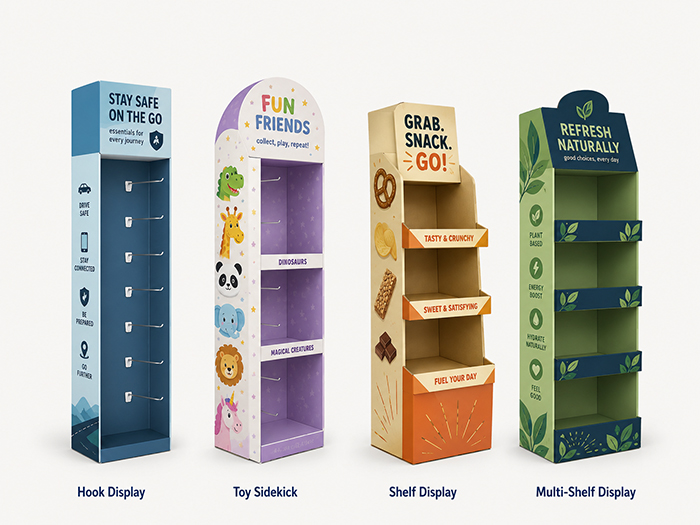
The material should match the promotion period, product weight, retail environment, and budget.
Cardboard Sidekick Display
A cardboard sidekick display is one of the most common options for short-term retail promotions. It is lightweight, cost-effective, easy to print, and suitable for seasonal campaigns.
Cardboard is often used for:Candy displays,Snack promotions,Trial-size products,Holiday campaigns,Lightweight packaged goods
Its main advantage is flexibility. It can be flat-packed or designed as a ready-to-display shipper. However, the structure must still be engineered properly, especially if the product load is not light.
PVC Sidekick Display
PVC sidekick displays are more durable than standard cardboard displays. They can be used for medium-term retail programs where the display needs a cleaner finish and stronger moisture resistance.
PVC is suitable for products that need a more stable display structure but do not require a full metal fixture.
Acrylic Sidekick Display
Acrylic is often used for beauty, personal care, and premium small products. It gives a clean, modern appearance and allows good product visibility.
However, acrylic should be selected carefully. It can scratch, and it may not be the most cost-effective option for short-term mass promotions.
Metal Sidekick Display
Metal sidekick displays are suitable for longer-term use, heavier products, or repeated retail programs. They offer stronger load-bearing performance and better durability.
The trade-off is cost and shipping weight. For large-scale promotional rollouts, metal may not always be the best choice unless the display is intended for repeated use.
A custom sidekick display should be developed around the product and the retail environment. Before design begins, several details should be confirmed.
Product Size and Weight
Product size and weight affect almost every part of the display:
Display width
Shelf depth
Hook spacing
Pocket height
Material thickness
Reinforcement method
Packing method
Full-load stability
If the product is light, a simple cardboard structure may be enough. If the product is heavier, the display may need stronger corrugated board, internal support, metal hooks, or a more durable material.
The best practice is to provide product dimensions, unit weight, packaging style, and expected display quantity before structural design begins.
Retailer Guidelines and Store Placement
Different retailers may have different requirements for fixture size, aisle clearance, hanging method, safety, color, material, and display setup.
Before ordering a custom sidekick display stand, it is important to confirm:
Where the display will be placed
Whether it will hang on a wire fixture or attach to a shelf
Maximum allowed width and height
Maximum projection into the aisle
Retailer approval requirements
Whether the display needs to ship pre-packed
A display that looks attractive in a rendering may still fail if it does not match store requirements.
Product Count and Replenishment
More product does not always mean better performance. A crowded sidekick display can look messy and make products harder to shop.
Good product count planning should consider:
Number of SKUs
Product facings
Replenishment frequency
Product visibility
Store staff handling
Sell-through target
The display should hold enough stock to support the promotion, but not so much that it becomes heavy, cluttered, or difficult to maintain.
Branding Area and Shopper Visibility
A sidekick display has limited space, so the graphic message must be clear. The most important areas are usually the header, side panel, and front-facing product zone.
Effective branding should:
Show the logo clearly
Use a short promotional message
Match the product packaging
Avoid too much text
Keep key product information visible
Guide the shopper’s eye toward the product
One common mistake is designing graphics before confirming how the products will sit on the display. Once the display is filled, some printed areas may be blocked. The structure and graphics should be planned together.
Assembly, Shipping, and Testing
A display that is hard to assemble may not be set up correctly in-store. A display that ships poorly may arrive damaged. Both problems reduce the value of the promotion.
For this reason, the design should consider:
Flat-pack or pre-packed shipping
Assembly steps
Instructions for store staff
Carton strength
Product protection
Full-load testing
Vibration and handling during transport
For international projects, packing efficiency is also important. A smart structure can reduce shipping volume and protect the display during delivery.
A standard display may work for simple products, but a custom sidekick display is a better option when your project has specific product, branding, or retailer requirements.
You should consider custom design when:
Your product has a special size or shape
The product is heavier than common lightweight items
You need multiple SKUs in one display
The display must match retailer guidelines
The promotion requires strong brand graphics
The display needs to ship flat or pre-packed
You want a more premium or durable structure
The display will be used across different retail channels
A custom design helps avoid common issues such as weak structure, poor product visibility, difficult replenishment, unstable loading, and inefficient shipping.
For brands preparing a new retail promotion, the most useful information to provide includes:
Product size
Product weight
Packaging format
Number of SKUs
Target retail channel
Store placement
Promotion period
Expected order quantity
Branding artwork
Shipping requirement
These details allow the manufacturer to recommend the right material, structure, printing method, and packing solution.
FAQs About Sidekick Displays
1.Is a sidekick display the same as a power wing display?
In many retail display projects, a sidekick display and a power wing display refer to a similar type of side-mounted promotional display. The exact name may vary by market, retailer, or manufacturer. When ordering, it is better to confirm the structure, placement, and installation method instead of relying only on the name.
2.What products are best for a sidekick display?
Sidekick displays are best for lightweight, compact, high-turnover products. Common examples include snacks, candy, gum, batteries, beauty samples, personal care items, small accessories, and seasonal promotional products.
3.Can a cardboard sidekick display hold heavy products?
A cardboard sidekick display can hold certain product loads if the structure is properly engineered. However, heavy products may require reinforced corrugated board, metal hooks, internal support, or a different material such as PVC or metal.
4.Where are sidekick displays usually placed in stores?
Sidekick displays are usually placed on the side of gondola shelving, near endcaps, along aisles, beside related product categories, or close to checkout areas. The exact placement depends on retailer requirements and the promotion goal.
5.What information is needed for a custom sidekick display project?
For a custom sidekick display project, you should provide product size, unit weight, packaging type, SKU quantity, target retail channel, store placement, promotion period, expected display quantity, artwork requirements, and shipping method.
Conclusion
A sidekick display is a compact but valuable tool for retail promotions. It helps brands create extra selling space, improve product visibility, support impulse purchases, and promote selected products without requiring a large floor area.
The best sidekick display is not simply the most eye-catching one. It should match the product’s size, weight, packaging format, store placement, retailer requirements, and promotion period. Structure, material, graphics, assembly, replenishment, and shipping all affect the final in-store performance.
For brands looking to develop a custom sidekick display or cardboard sidekick display for retail promotions, early design planning is important. With the right structure and production approach, a sidekick display can become a practical, cost-effective way to bring products closer to shoppers and improve retail campaign results.


3/F No. 6 Hedi Road, Gongming Street, Guangming District, Shenzhen City, GD, China, 518106


